Aloe vera's cooling reputation for sun-stressed skin runs ahead of the data, while a newer 2024 study on its actual hydration mechanism gets far less attention. Here's what the record supports and what it doesn't.
Aloe vera is one of the few skincare ingredients that never went out of style. It shows up in gels, after-sun lotions, and moisturizers marketed on a promise of instant relief for sun-stressed, dry, or reactive skin. That reputation is decades old, but a look at what's actually been measured tells a more specific story: some of aloe's best-known claims hold up poorly, while a newer, more technical finding about how it moves water into skin barely gets mentioned.
What's Actually Inside the Gel
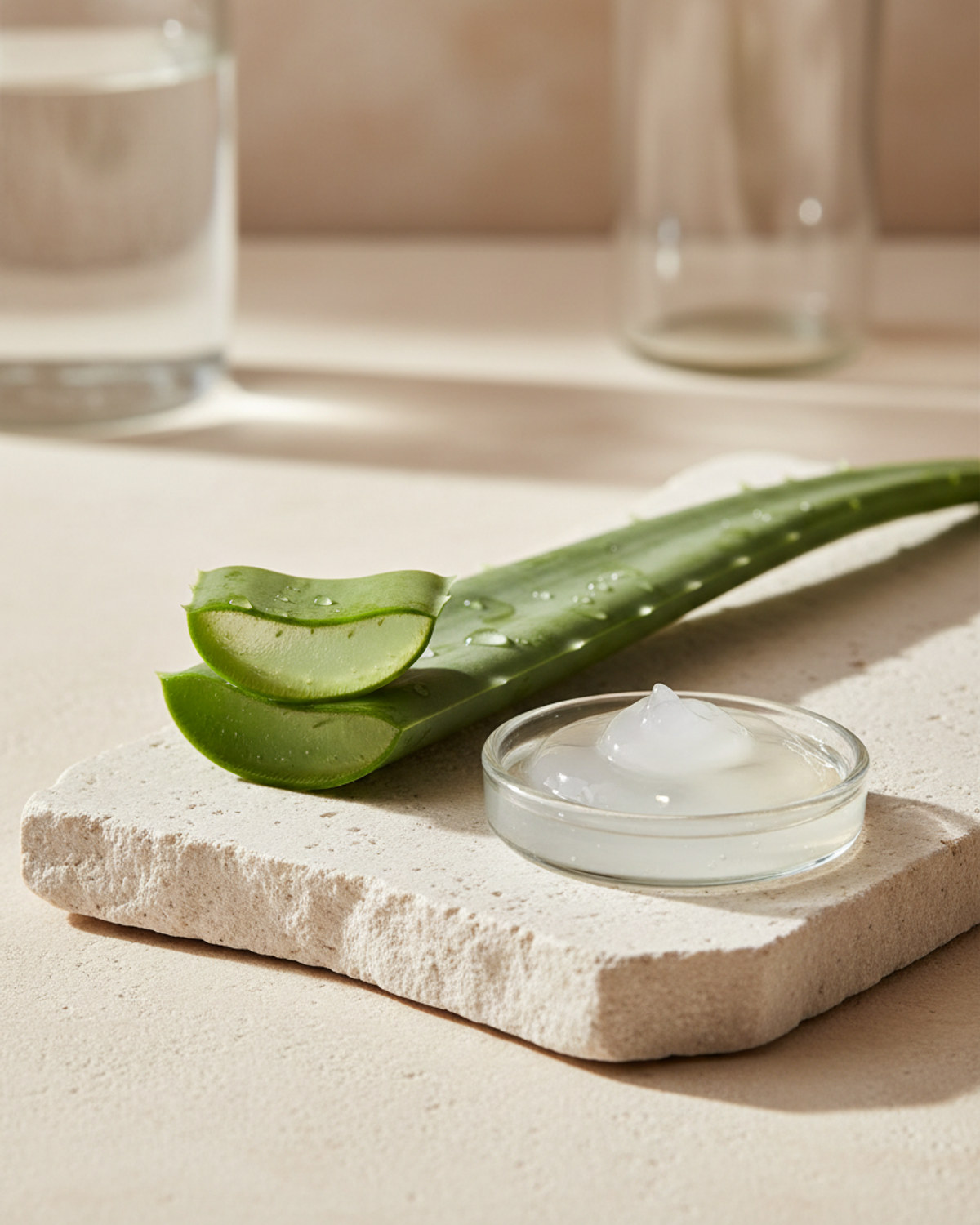
The gel comes from the inner leaf of Aloe barbadensis miller, and WebMD's supplement guide describes it as containing more than 75 active compounds, including enzymes, amino acids, vitamins, and minerals [6]. Cleveland Clinic's reviewed write-up adds that the gel carries antioxidant vitamins C and E [5]. The compound the industry treats as the real marker of authenticity is acemannan, a polysaccharide; the International Aloe Science Council states that only products with measurable acemannan content can accurately be labeled aloe vera [4].
That detail matters because a lot of what's sold as aloe vera gel on a drugstore shelf is mostly water, thickener, and a small amount of processed leaf extract. The compound doing the interesting biological work is a minor ingredient by volume.
The Hydration Chemistry a 2024 Study Documented
The most concrete recent data point on aloe and skin hydration comes from a March 2024 study in the journal Molecules, which tested an aloe vera extract combined with the amino acid derivative trimethylglycine [7]. In vitro, the combination increased expression of aquaporin-3, a water-channel protein that helps skin cells move and hold moisture, by up to 380 percent compared to untreated controls. In a follow-up clinical hydration test on human volunteers, the same blend produced a 236 percent jump in measured skin hydration within five minutes of a single application, and a 25.4 percent hydration improvement after 28 days of regular use, with the large majority of volunteers (93 percent) reporting a stronger moisturizing effect and no adverse reactions [7].
The important caveat: those numbers describe aloe vera paired with trimethylglycine in a specific formulation, not aloe gel applied on its own. A product that lists aloe vera near the bottom of its ingredient panel, with no trimethylglycine or comparable humectant system, isn't reproducing this result.
Where the Sunburn Reputation Falls Apart
Sunburn relief is probably aloe's single most repeated claim, and it's the one the evidence supports least well. Cleveland Clinic's review, checked by a board-reviewed dermatologist, states plainly that aloe vera won't reverse sun damage or make a sunburn disappear overnight, and cites research finding aloe performed no better than a placebo for treating sunburn in some trials [5]. Healthline's review reaches a similar conclusion: research doesn't support aloe vera actually healing or preventing sunburn, even though it can still feel soothing and has a real anti-inflammatory profile [2].
That distinction is worth sitting with. Aloe gel is cool, thin, and fast-absorbing, which produces an immediate sensory relief that people reasonably associate with healing. But feeling better and the skin barrier actually repairing faster are two different outcomes, and the second one is what the placebo-controlled research hasn't consistently shown.
The Blemish-Care Claims Are Thinner Than the Marketing Suggests
Aloe also gets marketed for oily or blemish-prone skin, and here the government's own health-information summary is unusually candid about the limits of the evidence. The National Center for Complementary and Integrative Health notes that only two small studies suggest topical aloe gel, used alongside other treatment, may improve the appearance of blemished skin — a much narrower claim than most product copy implies, and one that depends on aloe being used as an add-on rather than a stand-alone fix [1].
The same NCCIH summary flags a separate, more serious distinction: the International Agency for Research on Cancer has classified non-decolorized whole-leaf aloe extract, typically used in oral supplements, as a possible carcinogen — a concern about unprocessed whole-leaf extract taken by mouth, not about topical, purified gel [1]. A 2023 review NCCIH cites found that commercially available, food-grade drinkable aloe products were not genotoxic, which helps separate the whole-leaf-extract concern from the processed products actually sold for skin or drinking [1].
The Allergy Risk Almost No One Mentions
Aloe vera is a member of a plant family that includes garlic, onion, and tulip, and WebMD states that people with allergies to those plants show higher allergy susceptibility to aloe [6]. NCCIH separately notes occasional reports of burning, itching, rash, and skin reactions with topical aloe use [1]. None of this makes aloe a high-risk ingredient for most people, but it explains why a product marketed as gentle and calming can still trigger a reaction in someone with an existing plant sensitivity, and why a patch test on the inner forearm before applying a new aloe product to the face is a reasonable step rather than an overcautious one.
How to Tell a Real Aloe Vera Product From a Diluted One
Cleveland Clinic's dermatologist-reviewed guidance is specific: look for aloe vera gel as close to 100 percent as possible, and be wary of added fragrance, dye, or alcohol, which can irritate skin that's already stressed from sun or dryness [5]. The same review notes that aloe lotions performed less effectively than aloe gels in the sunburn research it cites, which is a useful distinction when a label just says aloe vera without specifying the format [5].
On the authenticity side, the International Aloe Science Council's certification seal is meant to verify truthful labeling, aloe quantity and quality against IASC's own standards, and sourcing from a certified processing facility [3]. The council's public FAQ also states that topical products should stay at or below 50 parts per million of aloin, the plant compound tied to irritation and the whole-leaf carcinogen concern above, citing Cosmetic Ingredient Review safety standards [4]. Checking an ingredient list for aloe near the top, rather than the bottom, is still the simplest practical filter available to a shopper without lab access.
Where Aloe Fits Into a Routine
None of this makes aloe vera a poor choice. It's a genuinely well-tolerated, lightweight humectant with real supporting chemistry for hydration, and it layers easily under heavier moisturizers or alongside ingredients like niacinamide and hyaluronic acid, which work through different, complementary mechanisms rather than competing with aloe for the same job. It's also a reasonable soothing layer to apply after a retinoid, when skin tends to run drier and more reactive than usual.
What it isn't is a sunburn treatment, a stand-alone answer for blemish-prone skin, or an ingredient where more is automatically better. The practical takeaway: treat a high-percentage, fragrance-free aloe gel as a hydration and comfort layer, not a repair product, patch-test it if you have known plant allergies, and don't expect it to undo sun exposure that sunscreen was supposed to prevent in the first place.