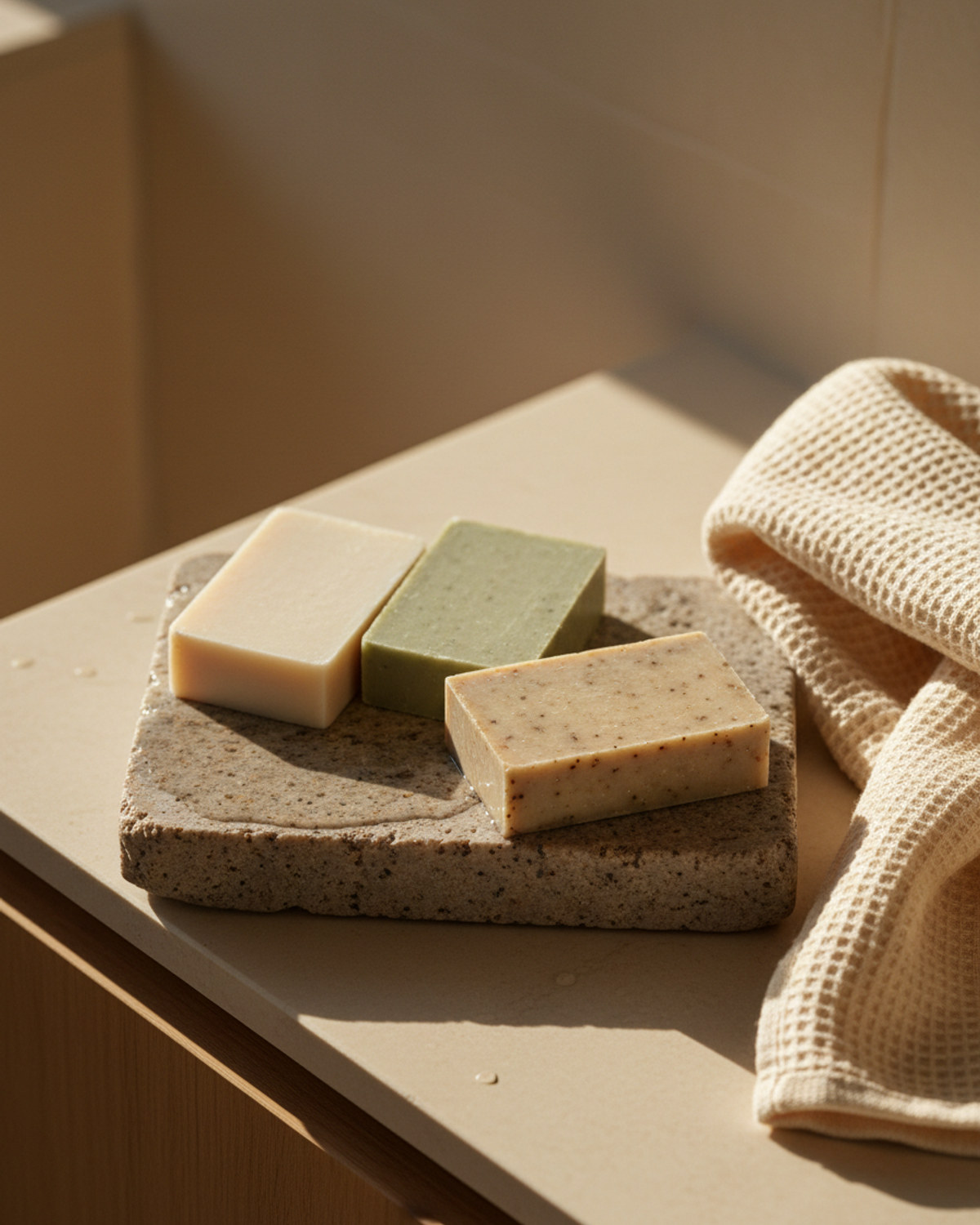
Beauty bar, cleansing bar and soap are not the same thing. Two small product surveys measured the pH gap, and the ingredient list shows which one you own.
Walk down a body-care aisle in late October and you will see bars labeled soap, beauty bar, cleansing bar and moisturizing bar, all within arm's reach. They look similar and often sit at similar prices, but they can be chemically very different, and the difference shows up as a single number: pH. As the air dries out this season, it is worth knowing what that number means and how to read it from a label.
Skin sits on the acidic side
The skin surface is mildly acidic. A 2014 paper on cleanser pH cites normal skin pH as about 5.4 to 5.9, and a 2024 survey of handwash products cites a range of 4 to 6. Cleansers are not meant to match that exactly, since they are rinsed off. The question is how far from it they sit, and what that does while they are on your skin.
What was measured in real products
Two small surveys put numbers on the gap. In the 2014 study, researchers dissolved 25 cleansers at 5 percent in tap water and measured pH. Bars made by saponification, the traditional soap process, landed at roughly 9.9 to 10.7 for antiseptic bars and 10.5 to 11.3 for general bars, while the one synthetic detergent bar, a syndet, was neutral. Mild liquids came in at 6.9 to 7.5.
The 2024 cross-sectional study measured 33 handwash products bought in Riyadh. Soap bars averaged pH 10.35, liquid soaps 6.00, and syndet bars 6.00; across all products, 48.5 percent were highly alkaline at pH 10 or above. The authors concluded liquids and syndets sit closer to the physiological range than soap bars.
These are useful snapshots with real limits. Both used small convenience samples, diluted products in water rather than testing them on skin, and measured pH only, not irritation or barrier function. The second study also reported slightly different liquid-soap figures in its abstract and its table. Treat the numbers as a pattern, not a guarantee for any one product.
Why pH matters beyond the number
A 2019 review in the Journal of Drugs in Dermatology states that alkaline soap cleansers are more irritating than synthetic surfactant cleansers, and attributes that to both the soap molecules and the high pH, while syndets work at neutral pH. It also notes that early work tied irritation potential to a surfactant's ability to denature proteins and swell cross-linked proteins. Two of its three authors have Unilever affiliations, so the paper sits close to the industry that makes these bars.
The 2014 authors make the barrier argument too: alkaline cleansers may raise skin pH, extract lipids and increase water loss, but their own study did not measure any of that on skin. In other words, the direction of the mechanism is well supported, while a clean head-to-head result for a given bar on your skin is not something these papers deliver.
Reading a label in one minute
Brands rarely print pH, so use the ingredient list as a proxy. This part is a general label-reading rule of thumb rather than something these studies tested:
- Saponified fats appear as sodium salts of fatty acids, for example sodium tallowate, sodium palmate, sodium cocoate or sodium palm kernelate. These point to a traditional soap.
- Synthetic surfactants such as sodium cocoyl isethionate point to a syndet.
- The words beauty bar, cleansing bar or moisturizing bar are marketing terms, so the product name alone is not enough. Check the list.
- Added moisturizers, such as glycerin or petrolatum, change how a bar feels but do not change the surfactant base.
Bars, liquids and what to expect
The Riyadh survey found liquid soaps were the most affordable option, at roughly SAR 14 on average against SAR 25 for syndets, and that heat and sunlight generally did not change pH meaningfully, though one table showed a significant liquid-soap shift after two weeks in sunlight. The practical reading: a syndet bar and a mild liquid wash are both reasonable picks if your skin feels tight after cleansing, and bar versus liquid is a smaller decision than soap versus syndet.
Surfactant mix matters beyond pH. The 2019 review describes combining surfactants and using amino-acid-based surfactants to make milder products, and notes the trade-off with lather that many people prefer. If you love a rich lather, expect a little more rinse-off effect.
A simple fall experiment
- Check your current bar or wash for sodium salts of fatty acids at the top of the list.
- For two weeks, swap in a syndet bar or a mild liquid wash for the body, keeping everything else the same.
- Keep showers lukewarm and short, and apply moisturizer within a few minutes of toweling off.
- Note how skin feels an hour after washing, especially on shins and forearms, where dryness shows first.
- If the swap makes no difference to you, there is no need to keep spending more.
If your skin feels uncomfortable or looks very red, stop and check with your doctor.
The takeaway
Traditional soap bars measured around pH 10 in two small product surveys, while syndets and mild liquids were near neutral, closer to the 4 to 6 range of skin. A bar that says beauty bar may or may not be a soap, so read the surfactants. If your skin feels tight after washing, test a syndet or mild liquid for two weeks and judge by how your skin feels an hour later.