Oat is sold as soothing, but colloidal oatmeal is a mix of starch, beta-glucan, avenanthramides and saponins. Here is what each part does and what the studies leave out.
Oat keeps turning up on ingredient lists, from cleansers to night creams, and it is usually sold with one word: soothing. That word hides a fairly specific story. Colloidal oatmeal is a finely milled whole-grain ingredient with a few distinct jobs, a long regulatory history in the US, and one honest caveat that rarely makes it onto the front of the bottle.
What colloidal oatmeal actually is
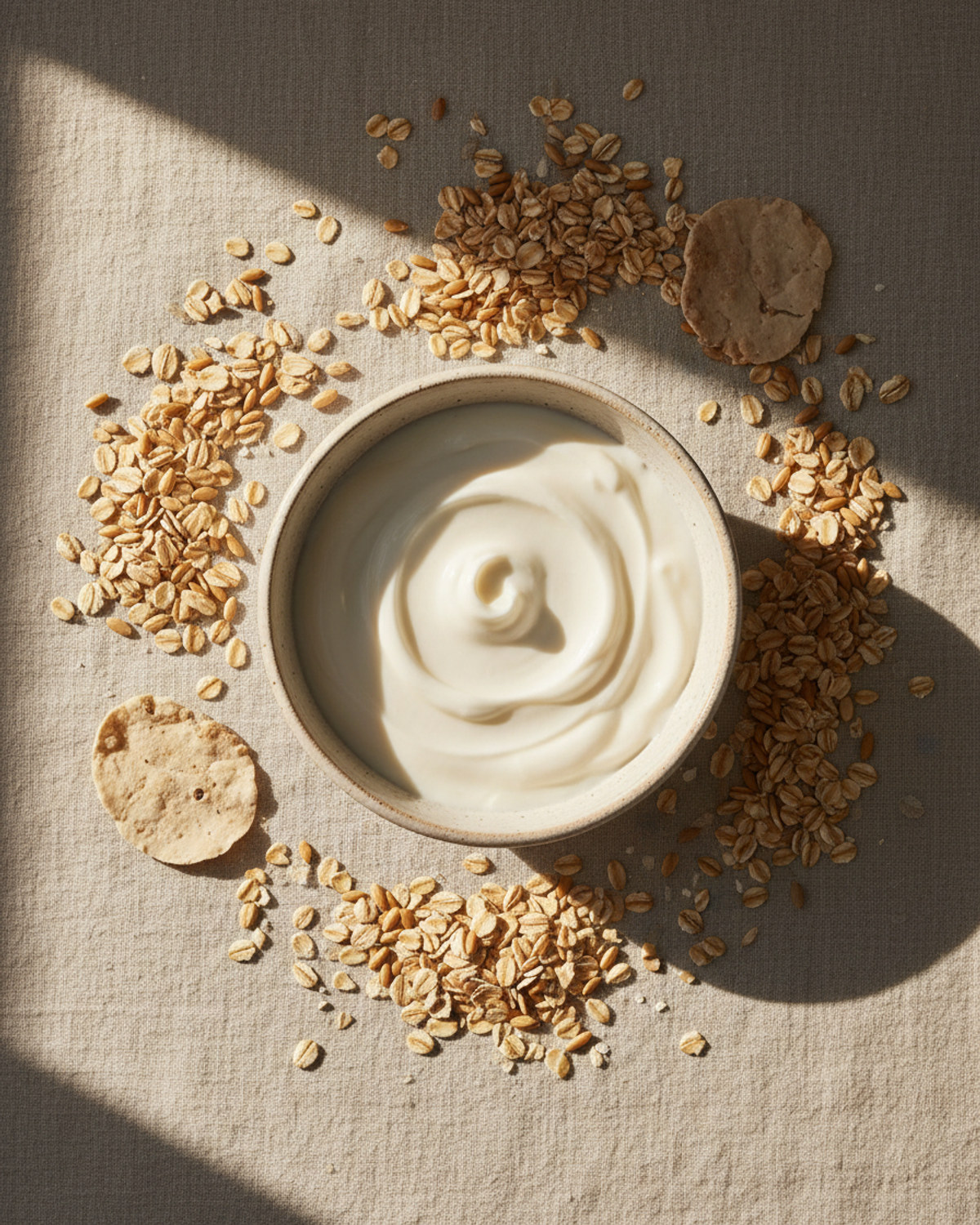
Colloidal oatmeal is oat grain milled finely enough to stay suspended in water or a cream. A dermatology review gives its rough make-up as 65% to 85% starch, 15% to 20% protein, 3% to 11% lipids, about 5% fiber and about 5% beta-glucans. Tucked inside that bulk are phenolic compounds called avenanthramides, present at roughly 300 parts per million, and saponins called avenacins, which account for oat's gentle cleansing action.
So it is not a single active. It is a mixture where starch and beta-glucan help hold water at the surface, avenanthramides are credited with the calming effect, and saponins let it work in a wash-off product.
Three jobs, three different parts
Holding water. A review of personal care products containing colloidal oatmeal attributes the hydrating effect to an occlusive film that binds water in the outer layer of skin. This is the same basic idea as any emollient, delivered by starch and beta-glucan instead of a petrolatum or ceramide.
Calming the look of irritation. The same review credits avenanthramides with inhibiting immune-driven skin inflammation. The dermatology review adds laboratory detail: oat extract was reported to reduce markers such as TNF-alpha and to inhibit NF-kappa B activity in keratinocytes. This is mechanism work, so read it as an explanation for why oat feels calming, not as proof of any particular result on your face.
Cleansing gently. The saponins in oat give it mild surfactant behavior, which is why oat shows up in bars and body washes aimed at dry, reactive skin.
What was measured on real skin
The strongest numbers come from a 2012 review that pooled personal care product studies. In repeat-insult patch testing across 12 studies and 2,291 subjects, 23 people (1.0%) had transient reactions during induction, and 14 (0.6%) had mostly transient low-level reactions at challenge. The authors concluded colloidal oatmeal has very low irritancy and sensitization potential.
In a body cream study of 50 women with dry skin, hydration, scaling and clinical dryness improved over the study, and benefits persisted for roughly two weeks after use stopped. On day 14 and day 28, between 63% and 100% of subjects reported a positive effect on dryness.
A 2025 literature review reported that colloidal oat emollients improved skin hydration and lowered transepidermal water loss, and described concerns about oat sensitization as unsubstantiated in most studies.
The caveats worth knowing
The data above leans on industry. The 2012 review was authored by researchers from a company that makes oat products, and the copyright line on the 2025 review lists a consumer health company. That does not make the findings wrong, but independent head-to-head trials against other moisturizers are what the 2025 authors themselves call for.
The same safety review also reported that the leave-on night cream had the highest self-reported adverse reaction rate in its in-use studies, 7 of 64 subjects (10.9%), and that a face and eye cleansing lotion study reported eye signs in 3 of 21 subjects (14%) that were possibly product-related. So 'oat' is not a guarantee that a finished formula is gentle. The rest of the ingredient list still matters.
Then there is sensitization. The dermatology review notes that oat sensitization was higher than expected in children with very reactive, impaired skin, and suggests repeated use of oat-containing cosmetics on a compromised barrier may play a part. Another study it cites found no sensitivity to topical colloidal grains in children under 2. The evidence points in both directions, which is a good reason to patch test.
How to choose and use it
- Look for colloidal oatmeal or Avena sativa (oat) kernel flour high on the list. In the US, colloidal oatmeal as a skin protectant falls under the over-the-counter skin protectant monograph issued in June 2003, which is why you will see it on drug-facts panels with a stated percentage.
- Read the label as a starting point. Fragrance, essential oils and a long active list can outweigh oat's calming reputation, as the in-use reaction rates show.
- Patch test first. Apply a small amount to the inner forearm or behind the ear for a few days before using it on your face, especially if your skin tends to react.
- Use it where it fits. Leave-on creams and lotions suit dry body skin, and a wash-off oat bar or bath suits sensitive areas where a stronger surfactant feels harsh.
- Give it two to six weeks. The body cream study measured dryness at 14, 28 and 42 days.
- Stop if something stings, itches or looks redder, and consider a different base.
The takeaway
Colloidal oatmeal is a well-documented, multi-part ingredient: it holds water, it carries avenanthramides credited with a calming effect, and it cleans gently. The published safety data are reassuring but largely company-sponsored, and a finished product's other ingredients decide how it behaves. Choose it for dry, easily bothered skin, patch test, and view a simple oat cream as a reasonable first move rather than a guaranteed one.