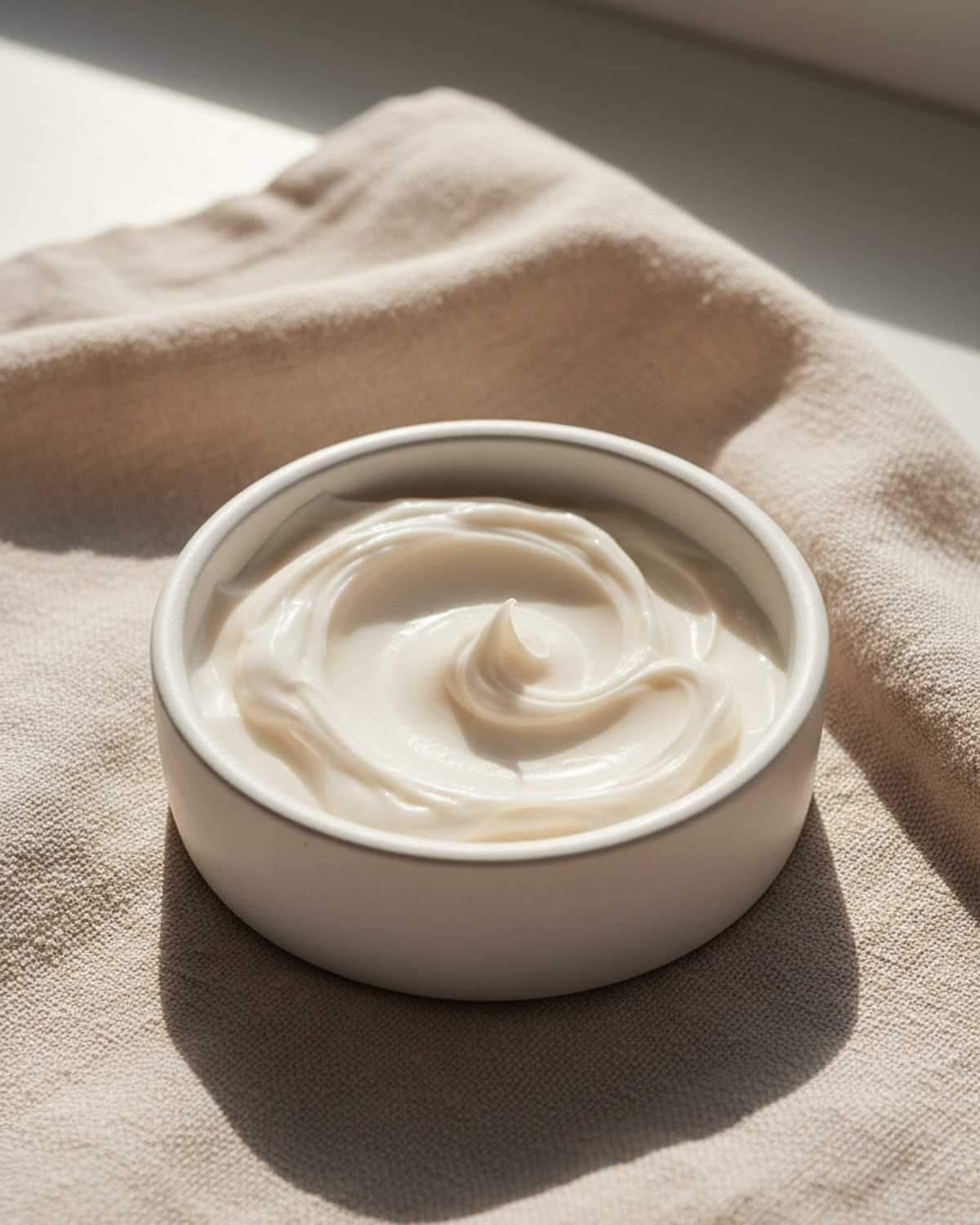
A balm that stays shiny on the surface is usually an occlusive working as designed. Here is what moisturizer research says about films, panthenol and how to adjust amount and timing.
A common question in skincare forums goes like this: a thick, soothing balm with panthenol is spread across the face and then just sits there, shiny and tacky, refusing to sink in. It is a fair complaint, and it has a straightforward explanation in how moisturizers are built. This guide covers why some creams stay on the surface, what the research says the 'sitting' layer is doing, and how to adjust your routine without giving up the product.
Why a balm can feel like it is sitting on top
Moisturizers combine three kinds of ingredients. Occlusives are oily or waxy and slow water loss from the surface, emollients soften and smooth, and humectants draw water toward the skin. A balm built mostly of occlusives and heavier emollients will, by design, form a film instead of absorbing like a water-based gel.
One review of moisturizer science notes that petrolatum, the classic occlusive, reduces transepidermal water loss (TEWL) by more than 98% when it makes up at least 5% of a formula, while lanolin, mineral oil and silicones reduce it by roughly 20 to 30%. The same review is blunt about the tradeoff: petrolatum is considered 'cosmetically less acceptable' because of its greasiness. A film that feels like it is sitting there is the occlusive doing its job, which is also why it does not vanish into the skin.
What the film is actually doing
The point of an occlusive layer is to slow evaporation while the barrier recovers. Humectants alone have a catch: the review calls them a 'double-edged weapon,' because water drawn into the outer layer can evaporate and raise TEWL, which is why they are usually paired with occlusives.
Panthenol (the alcohol form of vitamin B5, often listed as panthenol or dexpanthenol) sits in a different slot. A review of dexpanthenol reports that it acts as a moisturizer that improves stratum corneum hydration and helps keep skin soft and elastic, and that topical use is generally well tolerated with a low risk of irritation or sensitization. In a placebo-controlled setting it was associated with faster recovery of the barrier in an irritation model. These reviews summarize older, often manufacturer-linked work, so treat them as supportive and not definitive.
A newer pair of randomized studies tested a panthenol-containing emollient in healthy volunteers, using an intra-individual design (each person served as their own control). In the first, with 23 participants, TEWL fell more with the emollient than with the control over three weeks (an area-under-the-curve change of about -168 versus -123 g/m2/h, p = 0.023), and skin hydration improved significantly. Several authors were affiliated with the product's sponsor, and the volunteers were healthy people whose skin had been stressed with a detergent solution, not people with chronically dry skin. So the study supports panthenol-containing emollients helping with the look and feel of dryness, but it says little about one particular balm.
Five common reasons a cream will not sink in
- Too much product. Dispensing jars led to higher use (1.7 mg/cm2) than tubes (0.7 mg/cm2) in one cited comparison, and about half of an applied cream was still on the surface after 8 hours. A thick layer takes longer to settle.
- The skin underneath is already coated. Layering a rich balm over an oil or a silicone primer leaves little for it to blend with.
- Dry, cold skin. Occlusive oils tend to work best on moist skin, so a balm smoothed onto bone-dry skin can drag and sit.
- Skin that does not need it right now. Normal or oily skin may simply have no appetite for a heavy occlusive, and the film will feel exaggerated.
- Formula design. If the first ingredients are petrolatum, waxes or heavy oils, the surface film is the intended feel.
How to make a rich balm behave
- Use a thinner layer than you think. A pea-sized amount for the whole face is a starting point. Add more only to the areas that feel tight.
- Apply on slightly damp skin. Patting the face with a wet cloth or applying right after cleansing helps occlusives spread, and the same review suggests moistening skin before applying. One caveat: I could not find a controlled trial showing that damp-skin application hydrates better than dry-skin application, so the benefit may be mostly about how easy the product is to spread.
- Warm it first. Press the product between your fingertips for a few seconds and press, don't rub, onto skin.
- Move it to night. A visible film matters less under a pillow than under makeup or sunscreen.
- Keep a lighter layer for daytime. Apply a light hydrating lotion in the morning and reserve the balm for evenings or for the rougher areas around the nose and cheeks.
When to try something else
If a balm still looks heavy after two weeks of thin, damp-skin application, a lighter lotion or gel-cream is a perfectly reasonable swap. Emollient effects are reported to peak 30 minutes to 1 hour after use and last about 4 hours, so you may also need reapplication rather than a heavier layer. If your skin looks persistently red or feels like it stings after moisturizer, talk to a professional.
The takeaway
A moisturizer that sits on the skin is usually an occlusive doing exactly what it was built to do. Use less, apply it to slightly damp skin, and match the weight of the product to the time of day. Published work on panthenol supports its role as a hydrating, well-tolerated ingredient, but no study can promise a balm will sink in. Give any change two weeks before judging it.
Guidance that learns with you
Rituelle reads your skin over time and adapts your routine to it.
Join the waitlist