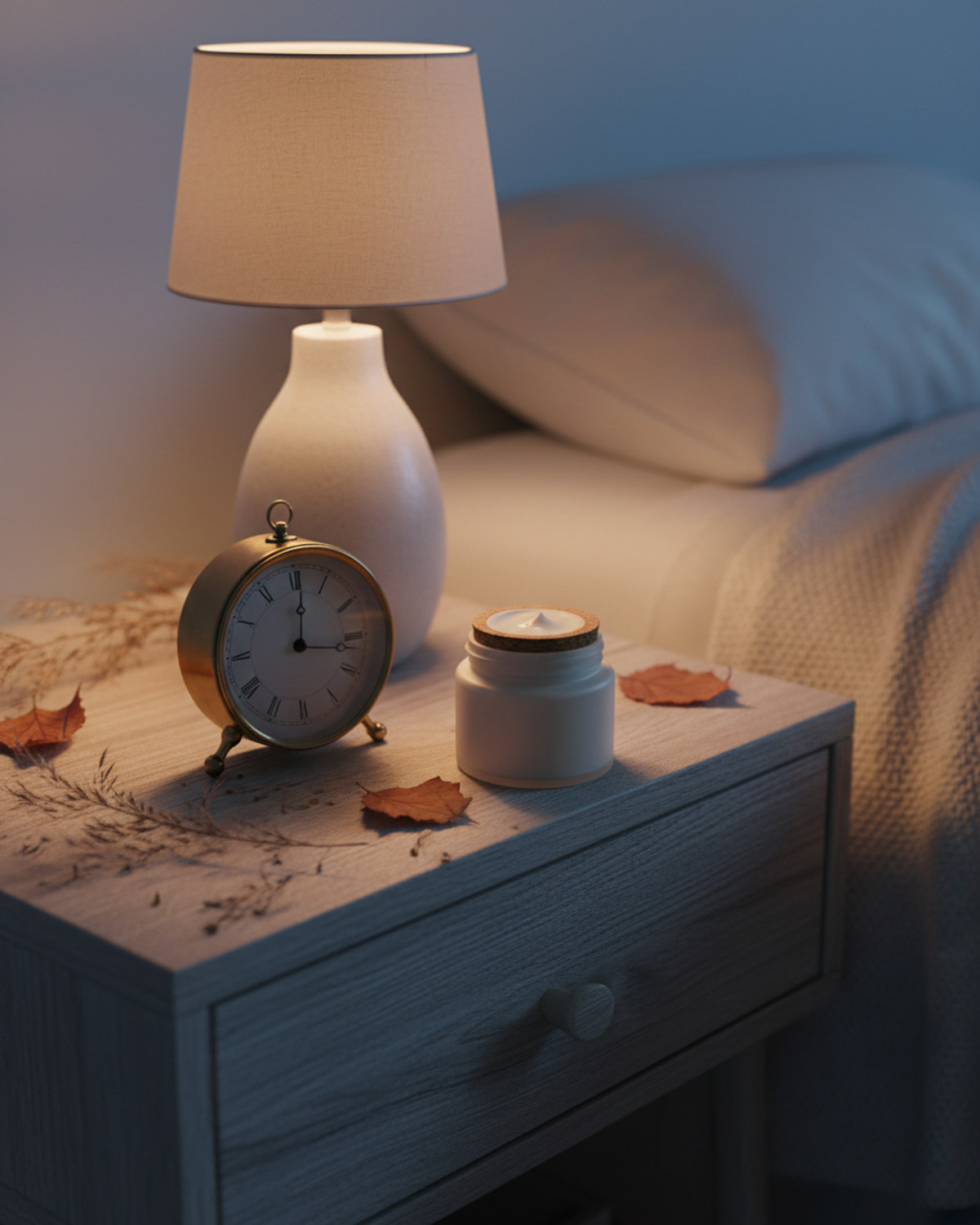
Daylight saving time ends Sunday, November 1, 2026. Here is what small studies and mouse research suggest about sleep, evening water loss, and how to time your moisturizer.
When clocks fall back on Sunday, November 1, 2026, at 2 a.m. local time, most of us get an extra hour in bed. It is a small, dateable nudge, and it makes a good moment to ask a bigger question: does sleep change how skin looks and behaves, and does the time of day you apply a moisturizer matter? The honest answer is that the evidence is real but modest, uneven in quality, and easy to oversell.
What actually changes on November 1
The calendar facts are simple. Daylight saving time ends at 2 a.m. local time on Sunday, November 1, clocks move back to 1 a.m., and phones and computers usually update on their own. Analog wall clocks, car dashboards, microwaves and ovens need a manual reset, ideally before bed on Saturday, October 31. Arizona (outside the Navajo Nation) and Hawaii do not change their clocks at all.
Nothing about your skin changes because of the clock itself. What matters is what the shift does to your sleep and light exposure over the following days, and how your evening routine lines up with your body clock.
Skin has a daily rhythm of its own
A 2019 review in the Journal of Clinical and Aesthetic Dermatology describes several skin functions that vary across the 24-hour day, including transepidermal water loss (TEWL), the amount of water evaporating through the skin surface. The authors note that skin permeability is higher in the evening than in the morning, and they link part of this to aquaporin 3, a water channel regulated by the skin's molecular clocks. The same review reports that skin temperature peaks in the afternoon and bottoms out at night.
Two cautions apply. First, the exact hour of peak water loss varies from study to study, so any claim of a precise window such as 9 to 11 p.m. should be treated as unproven. Second, the review itself is not fully consistent about repair timing: it says repair of UV-damaged cells is described as peaking at night, yet it also cites work finding one DNA repair enzyme more active in the morning, and lower in night-shift workers. The safe takeaway is directional: skin tends to lose more water toward the end of the day than in the morning.
What sleep loss did in the lab
Most of the strongest-sounding claims come from animal work, so it helps to be precise. A 2025 paper in Skin Pharmacology and Physiology put 24 male mice into two groups of 12 for eight weeks. One group had fragmented sleep, with a sweeping bar moving every two minutes, roughly mimicking the awakening frequency of severe sleep apnea.
- TEWL was higher in the fragmented-sleep group at 8 weeks, but not at 4 weeks.
- Epidermal thickness and dermal collagen density were lower.
- Of 133 genes with altered activity, 119 were down, and fatty acid metabolism was the most affected pathway.
The authors are open about limits: sleep disruption was not confirmed by EEG, only mice were studied, and the link between the altered pathway and visible skin changes remains unproven. This is a hypothesis-generating result, not a rule for people.
What poor sleepers showed in people
A study commissioned by Estee Lauder and presented in 2013 enrolled 60 premenopausal women aged 30 to 49, half of them classified as poor-quality sleepers. Poor sleepers scored 4.4 on an intrinsic skin aging scale versus 2.2 for good sleepers, and their redness after a UV challenge lingered past 72 hours. After a tape-stripping barrier challenge, TEWL recovery at 72 hours was 14% for good sleepers and negative 6% for poor sleepers.
Weigh that with care. The sponsor is a cosmetics company, the sample is small, it is a conference presentation rather than a full peer-reviewed trial, and the press release's own framing of a 30% difference does not match the 14 versus negative 6 figures, which differ by 20 percentage points. It shows an association, not proof that fixing sleep will change your skin.
Putting the pieces together for fall
Taken together, the sources point in one consistent direction without proving it: sleep and skin barrier behavior seem to be connected, and water loss tends to run higher later in the day. That supports a few low-risk habits, none of which depend on any single product.
- Moisturize in the evening, not just the morning. The 2019 review's authors suggest moisturizers may offer more benefit in the evening hours; that is a proposal, not an established guideline.
- Choose a richer texture at night. A cream with humectants plus an occlusive layer gives water something to hold onto while evaporation runs higher.
- Keep the first week simple. If the time change leaves you groggy, skip new actives. Adding exfoliating acids or a new retinoid while sleep is off adds variables you cannot untangle.
- Hold bedtime steady. Shift bedtime in small steps rather than one jump if you feel the change, and keep light dim at night.
A realistic evening routine for November 1 week
- Cleanse gently, with lukewarm water, as the last thing before your wind-down.
- Apply a hydrating serum to slightly damp skin if you like one.
- Seal with a ceramide or glycerin-based moisturizer, applied a bit more generously on cheeks and around the mouth, where wind and heat exposure are highest this time of year.
- Add a thin occlusive balm only where skin looks tight or flaky.
- Apply your usual morning moisturizer and a broad-spectrum sunscreen the next day regardless of the shorter, grayer light.
The practical takeaway
The extra hour on November 1 will not transform your skin, and no study cited here shows that a product can substitute for sleep. What the research supports is modest: skin loses water on a daily rhythm, poor sleep is associated with a weaker-looking barrier in small and animal studies, and a well-timed evening moisturizer is a cheap, low-risk way to support how skin looks and feels. Use the time change as a prompt to protect your sleep and tighten up your night routine, and talk with your doctor if skin changes persist or worry you.