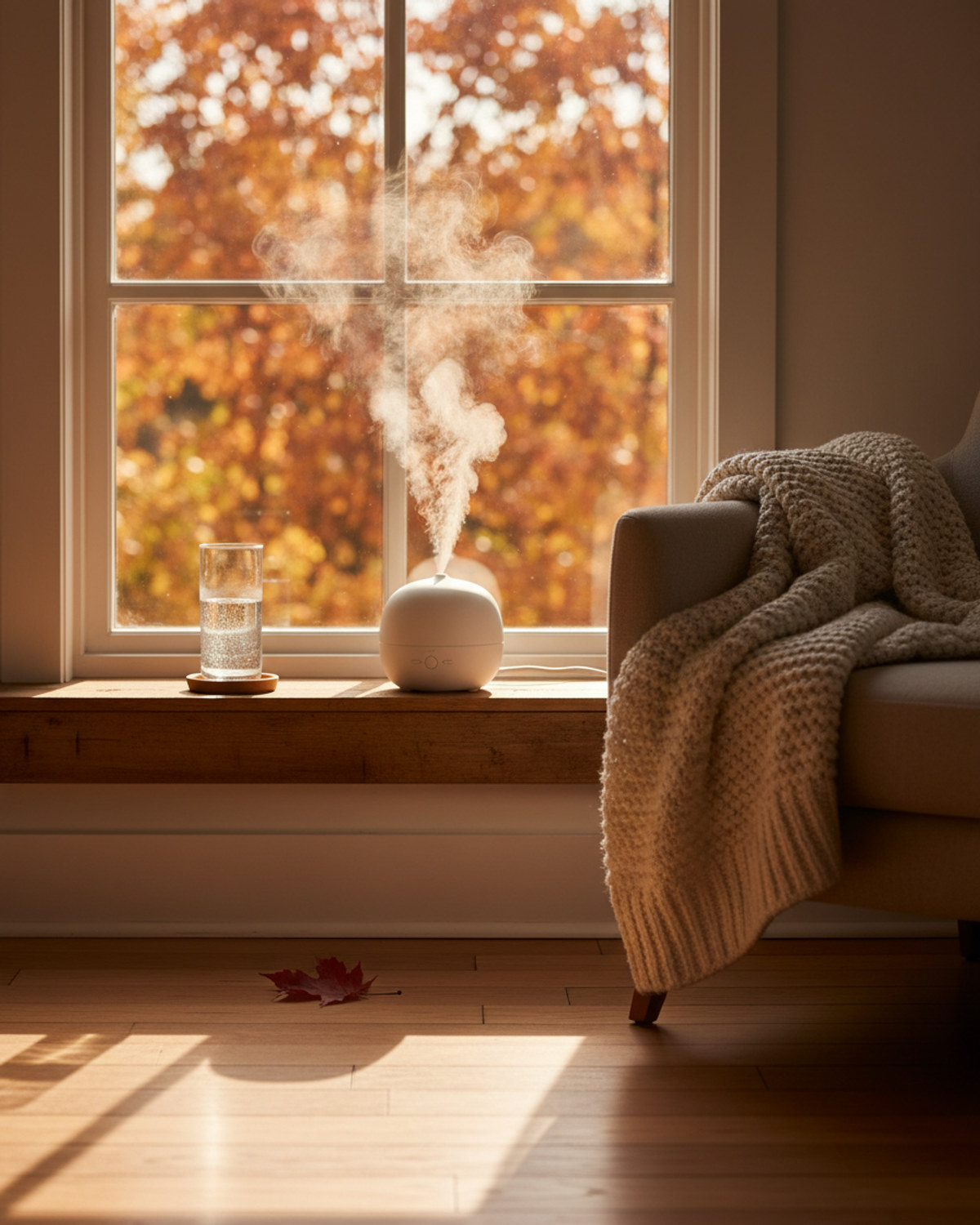
Heated indoor air can fall well below the 30 to 50 percent humidity range. Reviews link dry air to a weaker barrier, yet lab-grown skin shows surprising adaptation, so the useful advice is measured and modest.
When the heat comes on in autumn, the air inside a house can drop far below the humidity outdoors, and skin tends to feel it first. The research is more nuanced than the usual advice to just buy a humidifier. Lab studies suggest the outer skin layer can adapt to dry air, while broader reviews conclude that low humidity still weakens the barrier overall. This article sorts out what each kind of evidence can and cannot tell you, and turns it into a short, practical plan.
Why heated indoor air runs dry
Warm air can hold more water vapor than cold air. Outdoor air in cold weather carries little moisture, and when that air is brought inside and heated, its relative humidity falls sharply. A review of climate and skin explains why the distinction matters: relative humidity, absolute humidity and dew point are different measures, and cold, dry weather in particular is linked to a general decrease in barrier function. For a home, the practical number is relative humidity. The US Environmental Protection Agency advises keeping indoor humidity below 60 percent, ideally between 30 and 50 percent, mainly to limit moisture problems. That range is a useful target for comfort too, but it was written for building health, not skin.
What the broad reviews conclude
The most comprehensive source is a 2016 review in the Journal of the European Academy of Dermatology and Venereology. Its authors pooled the literature on humidity, temperature and seasons and concluded that low humidity and low temperatures lead to a general decrease in skin barrier function and make skin more vulnerable to mechanical stress. They also describe a plausible chain of events: skin cells release inflammatory signaling molecules, the number of dermal mast cells rises, and skin becomes more reactive to irritants. In plain terms, dry seasons are associated with skin that looks rougher and reacts faster to things it tolerated in summer.
Caveats are worth stating. A review summarizes many studies of varying quality, and much of the mechanistic work comes from animals and lab-grown skin. It is a strong argument that the effect is real, not a precise prescription for how many percentage points of humidity change a given person's skin.
The surprising lab result: skin adapts
Here is the twist. Two laboratory studies grew human epidermis models at different humidity levels and found that drier conditions triggered protective changes rather than simple damage.
In one, models kept at about 50 percent relative humidity were compared with models kept at about 100 percent. The drier models had more layers in the outer skin layer (17.8 versus 11.7), a higher density of the structures that bind surface cells together, about 2.5 times more filaggrin expression, and recovered electrical barrier resistance within 24 hours of a single tape strip while the humid models reached roughly 68 percent of baseline.
In the other, models held at 30 to 50 percent humidity for 10 days built a stratum corneum with about 1.8 times as many cell layers and lower water loss (7.7 versus 12.3 g per hour per square meter) than models kept above 95 percent. Breakdown products of filaggrin that attract water rose too, including a roughly 2.7-fold increase in pyrrolidone carboxylic acid.
Both groups of authors and the data are in vitro. The cells came from a handful of donors, they were not exposed to wind, heating cycles, hot showers or cleansers, and the authors of the second paper note that their findings do not establish what happens in living skin across seasons. These results show that skin cells can respond to modest dryness by reinforcing themselves. They do not show that a 20 percent indoor humidity level is harmless.
Reconciling the two pictures
The two bodies of evidence are not really in conflict. The lab models compare moderate dryness with a very humid culture setting that skin never experiences in life. The reviews look at real-world cold, dry exposure and report weaker barrier function and more reactive skin. A reasonable reading is that skin has an adaptation mechanism that works best with gradual change, while a sudden drop, such as the first week of central heating, happens faster than that response. That is an interpretation, not something either set of studies tested directly.
Where the humidifier evidence stands
Humidifier marketing is full of confident claims, so it helps to know how thin the independent proof is. I found one small trial, run by a manufacturer, comparing skin exposed to air at 55 percent humidity with skin in 25 percent air over three hours, and it reports higher stratum corneum hydration with humidified air. A three-hour, company-run test is not enough to conclude anything about weeks of winter living, so read it as suggestive only. The better-supported idea is simply that the 30 to 50 percent range is a sensible, low-risk target, and a small hygrometer costs less than a humidifier and tells you whether you need one.
A practical plan for the first weeks of heating season
- Measure first. Place an inexpensive hygrometer in the bedroom. If it reads within 30 to 50 percent, the air is probably not your main problem.
- Raise humidity gently if it is below 30 percent. Staying under 60 percent matters, because overly damp air carries its own risks.
- Lock water in right after washing. Moisturizer applied to slightly damp skin helps hold on to the water the cleanser left behind, and a cream with both a humectant such as glycerin and an occlusive such as petrolatum covers both jobs.
- Dial back what strips. Shorter, lukewarm showers and a gentle, fragrance-free cleanser matter more than any extra step.
- Introduce exfoliating acids and retinoids slowly. Skin that reacts faster to irritants in dry months may need a lower frequency than it tolerated in summer.
- Keep sunscreen in the routine. Low humidity does not remove UV exposure.
The takeaway
Dry indoor air is a real stressor on the skin barrier according to the reviews, while the lab data hint that skin is better at adapting than headlines suggest. The sensible response is modest and cheap: aim for 30 to 50 percent indoor humidity, seal in moisture after washing, and ease up on harsh steps until your skin has had time to adjust. If your skin stays tight, itchy or visibly flaky despite this, talk to a dermatologist.