Skincare advice repeats a two to three week timeline for skin to adjust to fall's lower humidity, but the water loss studies behind that claim actually disagree with each other, and two found no humidity link at all.
Every September, the same line shows up in fall skincare guides: give your skin two to three weeks to adjust to the season. It sounds like settled science. It is not. When you trace the claim back to the actual transepidermal water loss (TEWL) research it is supposedly based on, the picture is far messier, and in some cases the studies contradict each other outright.
The Claim Everyone Repeats This Time of Year
The logic behind the two-to-three-week window is simple: outdoor humidity drops, indoor heating hasn't started everywhere yet, and skin needs a lag period to rebuild its lipid barrier before dryness shows up as flaking or tightness. It is a tidy story. But a tidy story is not the same as a measured one, and the underlying water-loss science tells a more complicated version.
What TEWL Studies Actually Measured
TEWL is the standard lab measurement for how much water evaporates through skin, and it is the number researchers use as a stand-in for barrier health. A 2022 systematic review pulled together five studies that looked specifically at seasonal TEWL patterns. If the two-to-three-week adjustment story were simply true, you would expect a consistent finding: lower humidity months show higher water loss, every time. That is not what the review found.
Why the Studies Disagree With Each Other
One study in the review measured forehead TEWL at 21.41 g/h/m² in summer versus 17.40 g/h/m² in winter, meaning water loss was higher, not lower, during the warm months. Two other studies, working with different cohorts, found the reverse pattern: higher TEWL in fall and winter than in spring and summer, in the 17.4 to 18.2 g/m²/h range versus roughly 9.9 g/m²/h. A separate 2023 study measured 43 volunteers monthly from May through September and also found summer TEWL highest, at the same forehead site used in the earlier research. Same measurement, same body region, opposite seasonal direction depending on which study you read. That is not noise around a real effect. That is a body of research that has not converged on an answer.
Two Studies Found No Humidity Link at All
The systematic review went further and looked specifically at indoor room humidity, not just calendar season, since the two do not always track together. Two of the studies it covered tested humidity ranges between 30 and 70 percent and found no significant correlation between room relative humidity and TEWL. A larger study in the same review, with over 2,000 participants, did find a relationship, but it ran the opposite direction from the popular narrative: TEWL went down as both temperature and humidity went up, not the other way around. So even within the studies that did find an effect, the size and direction vary enough that a fixed two-to-three-week rule cannot be read out of them.
The Real Culprit Is Indoor Heating, Not a Biological Lag
None of this means fall skin complaints are imaginary. It means the mechanism is more specific than a body-wide adjustment clock. The Department of Energy's Brookhaven National Laboratory has published concrete numbers on what heating systems do to the air inside a home: typical indoor relative humidity runs around 65 percent in summer conditions and drops to roughly 40 percent once winter heating is running. The Environmental Protection Agency separately recommends keeping indoor relative humidity between 30 and 50 percent. Put those together and the room for error is narrow. Once a furnace or heater starts pulling indoor air below the EPA's floor, skin sitting in that air is dealing with an environmental condition, not a scheduled internal transition. That is also why symptoms can appear the same week a thermostat gets turned up rather than building gradually over a fixed number of weeks.
What Dermatologists Recommend Instead
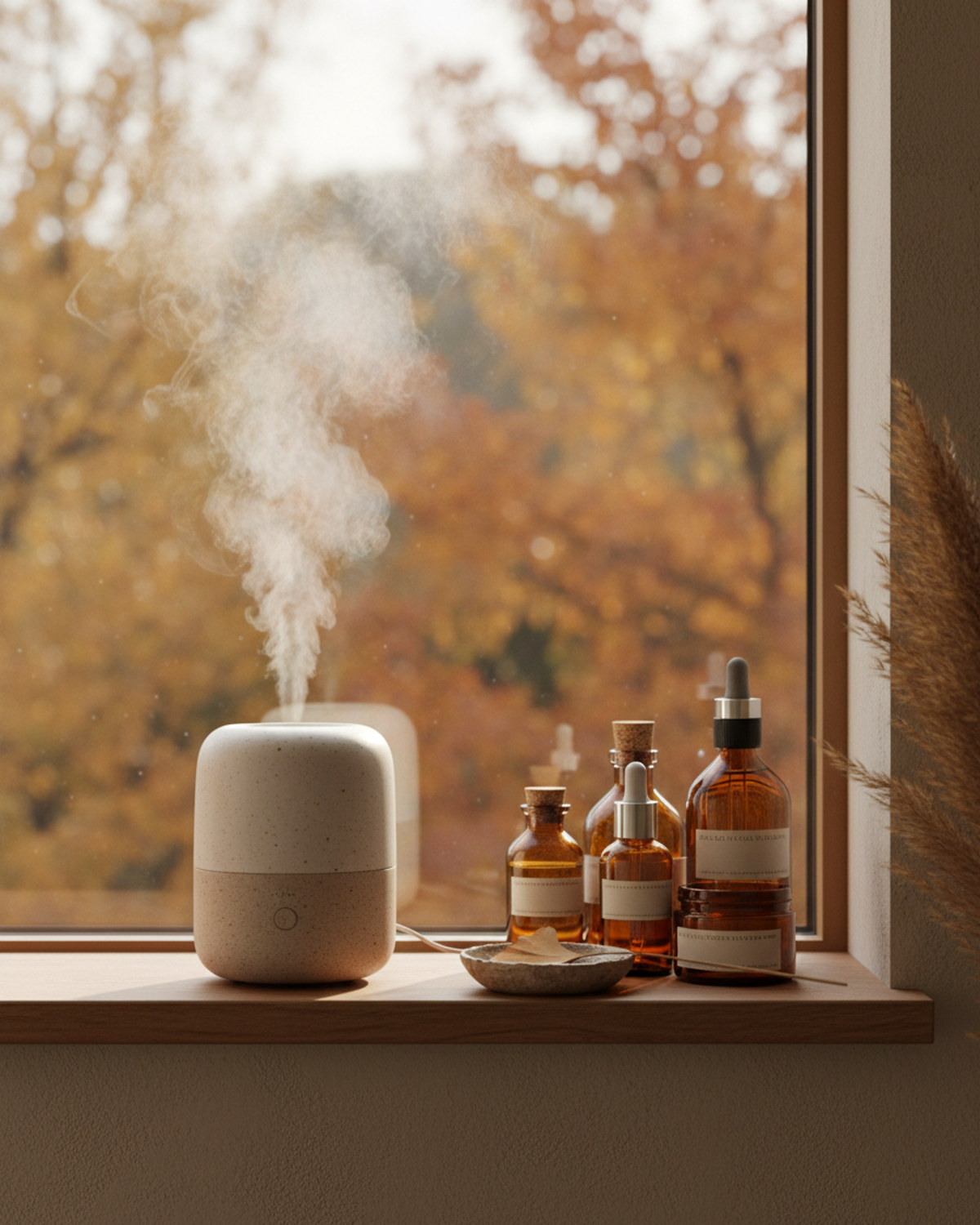
This is where the American Academy of Dermatology's actual guidance is more useful than the adjustment-period framing. The AAD's cold-weather advice does not mention a waiting period at all. It recommends switching to heavier creams or ointments in place of lighter lotions, pulling back on products with alpha or beta hydroxy acids since they can be more irritating once air is drier, and running a cool-mist humidifier in bedrooms to keep the air itself closer to that 30 to 50 percent range. Every one of those is a response to the current state of the air and the product routine, not a countdown clock. A dermatologist quoted in the AAD's guidance also flags a detail that gets skipped in most seasonal roundups: cranking the thermostat or running a fireplace makes the dryness problem worse, so bundling up in warmer layers indoors does more for skin than raising the heat does.
Reading the Research Correctly This Fall
None of the contradictions above mean the underlying idea, that fall air is often harder on skin than summer air, is wrong. Multiple studies in the same review did find a real relationship between lower humidity and higher water loss, just not a uniform one, and not on a fixed timeline. What the research actually supports is narrower and more useful than the popular version: watch the air your skin is actually sitting in, particularly once indoor heating starts, rather than counting down a set number of weeks after Labor Day. A hygrometer that shows indoor humidity has fallen into the 20s or low 30s tells you more than a calendar date does.
A Practical Takeaway
Skip the fixed timeline. Instead, track two concrete things this month: whether your indoor heating has kicked on yet, and what your indoor humidity actually reads if you have a hygrometer or a smart thermostat with a humidity sensor. If indoor air is still above 40 percent, a product switch may not be necessary yet regardless of the date on the calendar. Once it drops toward the 30 percent mark or below, that is the point supported by both the EPA's guidance and the AAD's recommendations to move to a heavier moisturizer, ease off exfoliating acids, and add moisture back into the room itself with a humidifier, rather than waiting out an adjustment period that the water-loss research never actually established.