HOCl sprays are trending, but the active molecule is fragile. Here is what published sources say about pH, sunlight, post-opening shelf life, and how to choose and store a bottle.
Hypochlorous acid (HOCl) sprays have moved from aesthetician treatment rooms to bathroom shelves, and the pitch is simple: your own white blood cells make it, so a mist of it must be gentle and useful. The first half of that is true. The second half depends on something the marketing rarely mentions, which is whether the bottle in your hand still contains much active HOCl by the time you spray it.
What HOCl is, and why people use it
HOCl is a small molecule produced naturally by the body's immune cells, and a 2024 review in the Journal of Drugs in Dermatology notes its medical use as a wound rinse dates back to World War I. In skincare it is used as a light mist, often after cleansing or after a workout, by people who want a lightweight step that suits skin that looks reactive or easily flushed. The research base is real, but it is strongest for wound care and post-procedure skin, not for the everyday-cosmetic claims common on social media.
The catch: it is chemically fragile
Active HOCl exists only in a narrow window. The 2024 review reports it is stable between a pH of about 3.5 and 5.5, and outside that range the amount of HOCl falls while hypochlorite, a form with less microbicidal activity, rises. A Dermatology Times explainer from May 2026 puts the most biologically active zone at pH 4.0 to 6.0 and warns that a formula drifting out of range may deliver mostly hypochlorite instead. In plain terms, two bottles with the same name on the front can behave very differently on your skin depending on pH and age.
Light and heat are the enemy
The review cites a study of how sunlight affects shelf life: chlorine loss began on day 4 in a solution left in the sun, versus day 14 in a sun-sheltered one. Dermatology Times adds that heat, light and time after opening can all inactivate active HOCl. That matters for a product people tend to keep on a sunny windowsill, in a gym bag in a hot car, or on a bathroom counter near a heated shower.
How long a bottle really lasts
Published, independent shelf-life data on consumer sprays is thin, so treat any single number with caution. Here is what the better sources say:
- Sealed shelf life: Stabilized commercial products list 12 to 24 months when stored correctly, meaning below 25 degrees Celsius, in opaque containers, away from UV light.
- After opening: The same explainer gives an estimate of 30 to 90 days under typical conditions, because the spray mechanism lets air in, and light, temperature swings and nozzle contamination add to the loss.
- Concentration is not a simple upgrade: Dermatology Times reports that formulations at 500 ppm and above can degrade faster than moderate ones in the 200 to 300 ppm range.
- Manufacturer-linked claims: A 2018 review describes a specific pH-neutralized formulation stable for up to two years, but its authors disclosed consulting honoraria from the maker, so read it as a claim about one formulation, not about all sprays.
What the evidence does and does not support
The 2024 review and the 2026 explainer agree on the broad picture: HOCl has antimicrobial and soothing-related properties documented in lab and clinical settings, with the longest track record in wound care. Neither source supports the idea that a daily mist replaces established products from a prescriber, and the 2026 explainer says dedicated evidence for redness-related and flaking-scalp uses remains limited. Use it as a light extra step, not as the foundation of a routine.
How to pick and use a bottle
- Look for a concentration in ppm on the label. If the brand will not tell you, you cannot judge what you are buying.
- Choose opaque packaging. A clear bottle that lets light through works against the one variable you can control.
- Check for a date or a post-opening window, and write the opening date on the bottle with a marker.
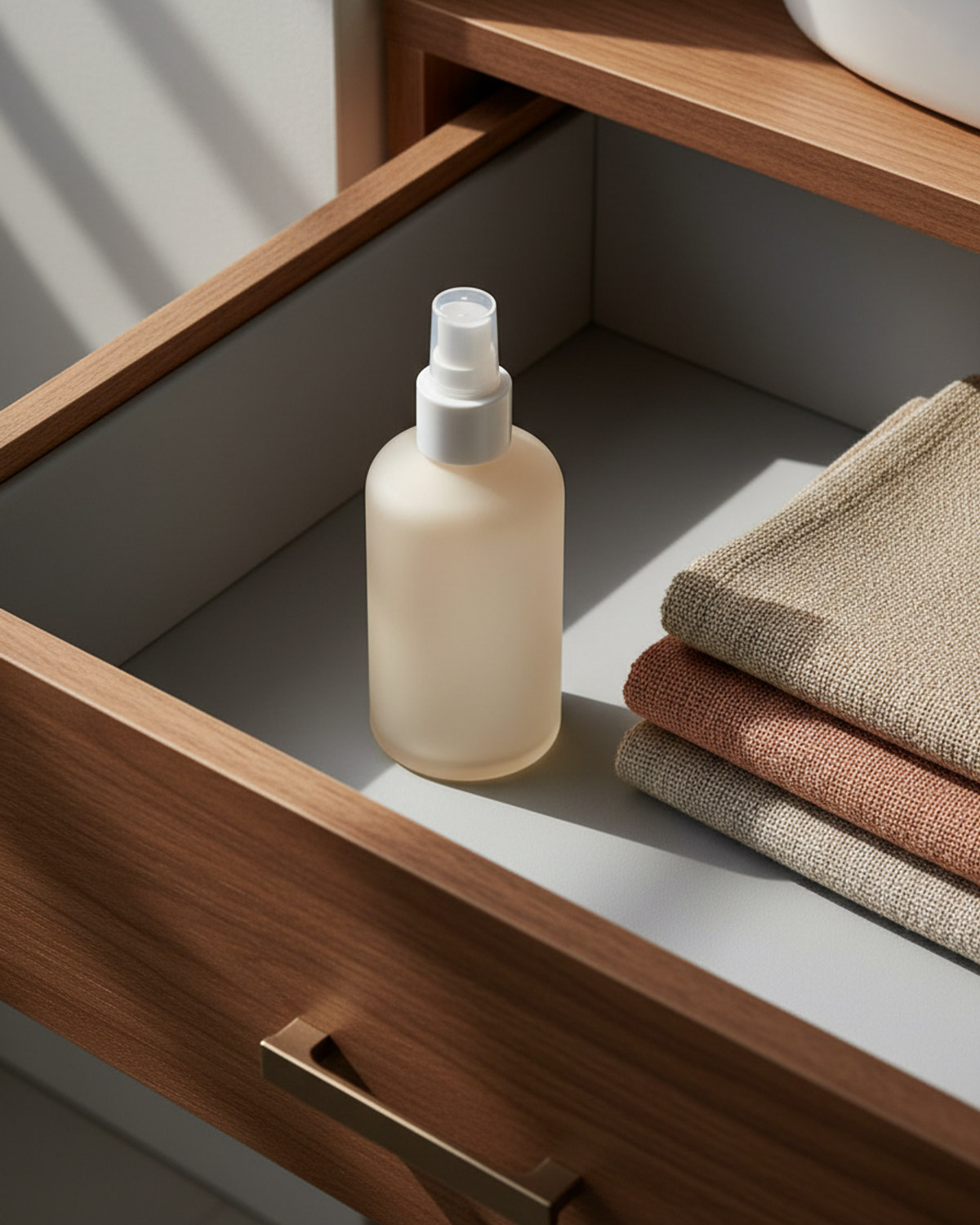
- Store it cool and dark, such as a drawer, not a windowsill or a car.
- Plan to finish it within about two to three months of opening, in line with the 30 to 90 day estimate.
- Skip refilling or decanting into travel bottles, since extra air and light exposure speed up the loss.
- Layer it simply. Mist on clean skin, let it dry for a moment, then follow with your usual moisturizer and, in the morning, a broad spectrum sunscreen. FDA guidance is SPF 15 or higher, reapplied at least every two hours in the sun. If you are pregnant, talk to your doctor about products during pregnancy before adding new ones.
The takeaway
HOCl is a legitimate ingredient with a long history, but the bottle matters more than the buzzword. Pick opaque packaging with a listed ppm, keep it away from heat and light, mark the opening date, and expect to replace it within a few months. A fresh, well-stored mist can be a pleasant light step for skin that looks reactive. A half-used bottle that has spent a summer on a sunny shelf may be little more than lightly salted water.
Guidance that learns with you
Rituelle reads your skin over time and adapts your routine to it.
Join the waitlist