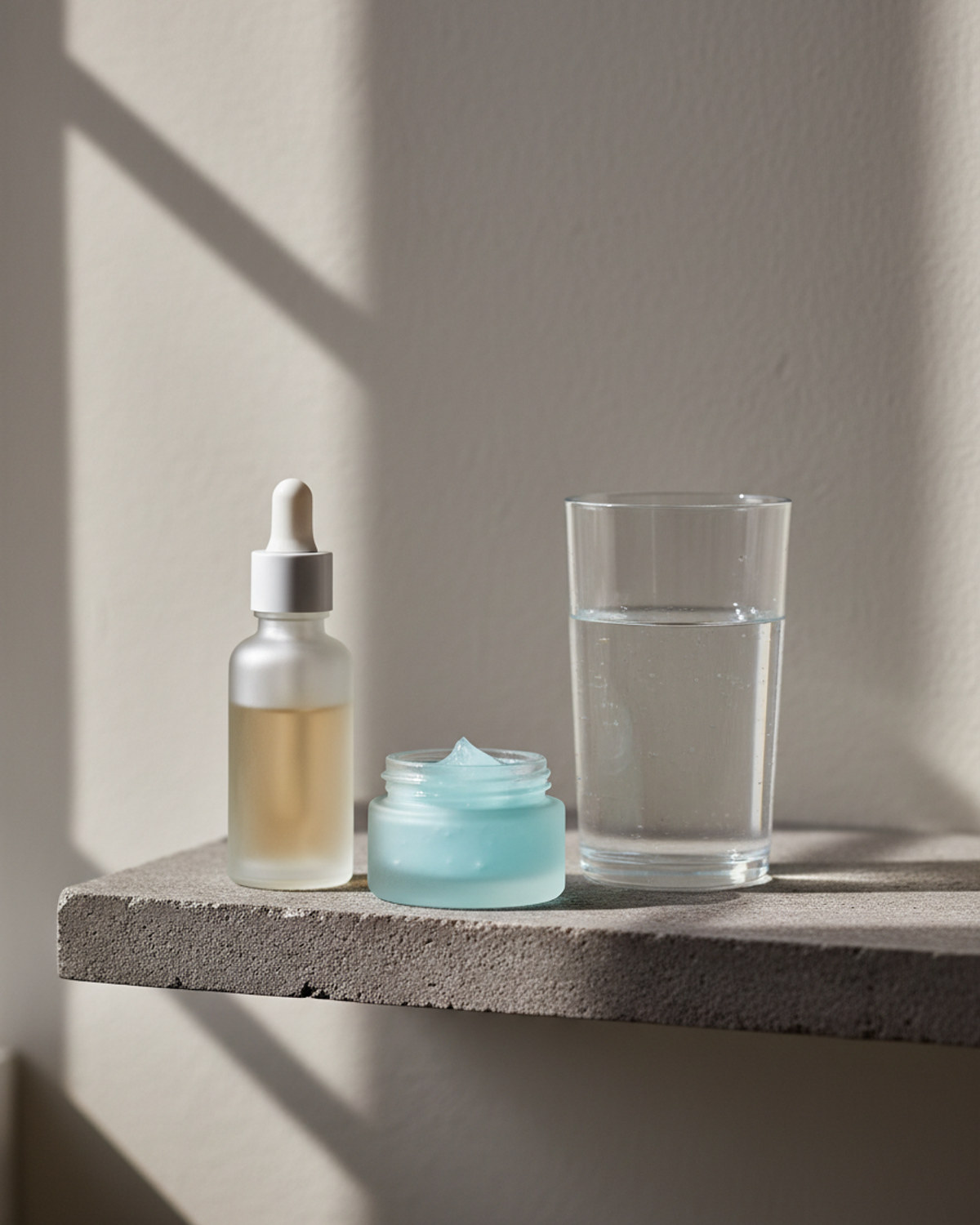
A 62-woman measurement study found oilier skin was not the most hydrated, and a 27-woman trial saw hydration rise without any change in oil output. What that means for an oily-skin routine.
If your forehead shines by noon, it is natural to assume your skin has more than enough moisture and that a moisturizer would only add to the shine. A small set of measurement studies suggests that assumption is shakier than it sounds. Oil on the surface and water inside the outer skin layer are two different things, and they do not always move together.
Oil and water are measured separately
Researchers track oiliness with two numbers: casual sebum level, the oil sitting on the surface right now, and sebum excretion rate, how fast it is produced. Hydration of the outer skin layer is measured separately with a probe called a corneometer. Because these are separate instruments measuring separate things, a person can score high on one and unremarkable on the other.
What 62 women showed
A 2020 study in Skin Research and Technology by Thadanipon and Kitsongsermthon recruited 62 healthy Thai women who described their own skin as either oily or dry and measured several facial sites. Sebum levels and excretion rates were 1.6 to 2.1 times higher in the oily group, so self-described skin type matched oil output well.
The surprise came from hydration. Corneometer readings were significantly higher in the dry-skinned group than in the oily-skinned group, and hydration correlated negatively with surface oil. In plain terms, the women whose faces looked and felt oiliest did not measure as the most hydrated. The authors concluded that subjective skin type tracked sebum but not hydration.
Pore measures did not differ between groups either, and did not correlate with oil. One cautious reading: how your skin looks and feels in the mirror is a decent guide to oil, and a poor guide to water content.
A caveat on scope: this was a single study of women in one country, grouped by self-description, and it shows association at one point in time. It cannot say that being oily causes lower hydration.
A 27-person trial where oil did not change but hydration did
The second piece of evidence is a four-week trial in the Thai Journal of Dermatology with 27 women who had oily, sensitive-feeling skin. Participants used a weakly acidic foaming cleanser, an aqueous lotion and a moisturizing gel twice a day.
Sebum secretion rate did not change. Water-holding capacity and barrier function rose significantly, and the stinging response to a lactic acid test fell. Redness and blemish counts also improved, and no adverse events were attributed to the products. The authors read this as benefits coming from hydration and barrier support rather than from reduced oil production.
Two limits apply. The abstract does not report the numeric values, and the study had no comparison group of women who skipped the moisturizer. So it supports the idea that a light moisturizing step did not appear to raise oil output in this group, but it cannot prove the products caused the improvements.
The comparison that tempts people: oil-stripping products
If oil is the visible problem, stripping it feels logical. A 2023 trial of a clay mask used twice weekly for four weeks in adults with oily or combination skin reported lower sebum, higher hydration and lower water loss through the skin over the month. At face value that sounds like a win for oil-control products.
Read it carefully, though. The study was funded by L'Oreal and written by L'Oreal employees, it had a single group and no vehicle control, it tested one branded formula, and it reported mostly percent changes without absolute values. It is a data point about that product, not a rule that clay masks improve hydration. Its main value here is showing that oil and hydration were tracked together and moved in the favorable direction for that formula, which is the opposite of the old idea that you must trade one for the other.
What this means for a routine
Put the three studies together and a modest, hedged picture emerges:
- Shine is not a hydration reading. Surface oil tells you little about water content in the outer layer.
- A light moisturizing step is a reasonable fit for oily skin. In one small trial, it came with better hydration and barrier readings without a change in oil output.
- Be gentle with cleansing. The American Academy of Dermatology advises a gentle, alcohol-free cleanser, lukewarm water, fingertips instead of scrubbing tools, and washing no more than twice a day plus after heavy sweating.
- Choose texture for how you live with it. Gels, lotions and other lightweight formats are the ones used in the trial above. If a product feels heavy or leaves a film that bothers you, switch texture rather than skipping the step.
Try it for two weeks
Wash morning and night with a mild cleanser and lukewarm water, pat dry, and apply a thin layer of a lightweight moisturizer to slightly damp skin. Leave everything else in your routine alone for two weeks so you can tell what changed. Note how your skin feels at midday, whether tightness has eased, and whether shine looks any different at the same time of day.
If the shine is unchanged but the skin feels more comfortable, that matches what the research suggests: oil and hydration are separate dials, and turning one down does not turn the other up. If a product makes you feel greasier or more irritated, stop using it and talk with a dermatologist about your own skin.