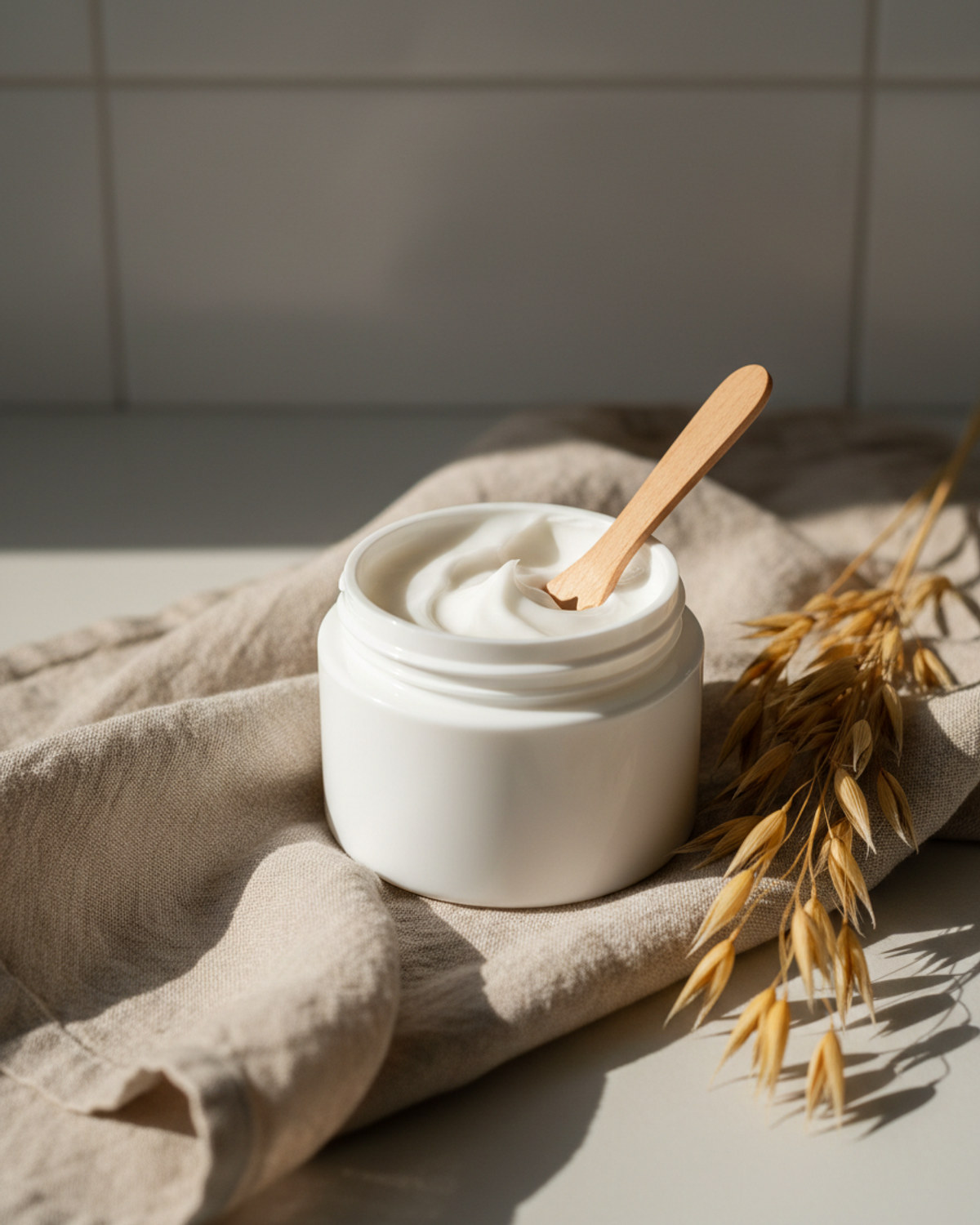
Panthenol appears on countless labels, yet few people know what it is supported by. Here is what published trials measured for hydration and barrier look, and where the evidence stops.
Panthenol shows up in cleansers, toners, sunscreens, hair products and moisturizers, usually near the bottom of the ingredient list, and it rarely gets the attention that niacinamide or retinol does. It deserves a closer look, because its published research is unusually consistent on one point: it supports how hydrated and smooth the skin surface looks and feels. This guide covers what it is, what the studies measured, what they did not, and how to fit it into a routine.
What panthenol is, in plain terms
Panthenol is the alcohol form of pantothenic acid, also known as vitamin B5. Dexpanthenol is the form most often named in the research. A 2002 review describes it as the stable alcoholic analog of pantothenic acid and says topical use rests on good skin penetration when it is delivered in a suitable vehicle, such as a water-in-oil emulsion. In tissue it is converted to pantothenic acid, a component of coenzyme A, which takes part in early steps of fatty acid and sphingolipid synthesis. Those lipids matter because they build the stratum corneum, the outermost layer of the skin.
That biochemistry is the stated rationale, not a proven pathway for every product. A 70th-anniversary review notes that although dexpanthenol was discovered decades ago, its exact mechanisms of action have not been fully worked out. What the review does say is that dexpanthenol appears to increase the mobility of stratum corneum components that matter for barrier function.
What the trials actually measured
The best-known study is a randomized comparison from 2002 using an irritation model. Researchers irritated skin with sodium lauryl sulphate, then applied either a dexpanthenol cream or its vehicle twice daily. They found significantly accelerated barrier repair with the dexpanthenol cream compared with the vehicle or with untreated skin. Both creams raised stratum corneum hydration, but the dexpanthenol cream did so significantly more, and while both reduced roughness, the active cream did better. It also significantly reduced skin redness, while the vehicle had no effect on it.
A separate randomized, double-blind, placebo-controlled study tested dexpanthenol in two lipophilic vehicles for seven days. Treatment improved stratum corneum hydration and reduced transepidermal water loss, and the active product differed statistically from the vehicle on both measures.
A third source is a pair of randomized studies of a panthenol-containing emollient, published in 2017. In the first, 23 people had one skin area challenged with 0.5% sodium dodecyl sulfate solution, and both challenged and unchallenged areas were treated for three weeks. The mean area-under-the-curve reduction in water loss from baseline was larger with the emollient than with the control, at -168.36 versus -123.38 g/m2/h (p = 0.023). Hydration also improved significantly.
What those numbers do not tell you
Read these studies carefully before you assume a bottle of panthenol serum will do the same thing.
- The tested products were finished creams, not single ingredients. The 2002 and 2017 studies used formulated creams or emollients, so the benefit belongs to the whole product, including its oils and humectants.
- Vehicles also helped. In the 2002 study, the plain vehicle raised hydration too, just less than the active cream. A good moisturizer does some of this work by itself.
- The irritation models are artificial. Detergent-challenged skin is a controlled stress test. It resembles a tight, over-washed face better than it resembles a routine day, but it is not the same thing.
- No study we opened compares concentrations. Percentages were not presented in the abstracts we reviewed, so any claim that 5% beats 2% is not supported by what we read.
- Mechanism is incomplete. The reviewers themselves say so.
Who tends to find it useful
Because the research centers on hydration, water loss and surface roughness, panthenol is a sensible fit for skin that feels tight after cleansing, looks rough or flaky in cold and dry months, or is recovering from over-exfoliation by acids or retinoids. The 2002 review also reports that topical dexpanthenol preparations are usually well tolerated, with minimal risk of skin irritancy or sensitization. That reputation for tolerability is why it often appears in products aimed at reactive-feeling skin. Still, usually well tolerated is not the same as never reacts, and any product can disagree with an individual.
How to use it in a routine
Panthenol plays well with most other ingredients, since it is a humectant-like, non-acidic ingredient and has no pH requirement the way acids do. A simple approach:
- Look for it in the leave-on step. Panthenol in a rinse-off cleanser spends seconds on your skin. The studies above all involved products left on the skin.
- Pair it with an occlusive or emollient base. The 2002 review specifically pointed to water-in-oil emulsions as a good delivery vehicle, and the lipophilic-vehicle study found benefits in both bases it tested. A cream will usually outperform a thin watery serum for this purpose.
- Use it after active nights. If you use a retinoid or exfoliating acid, a panthenol-containing moisturizer on the following morning fits the barrier-support pattern the studies modeled.
- Give it time. The shortest benefit window in these sources is seven days, and the emollient study ran three weeks. Judge a product by how your skin feels and looks over a few weeks rather than overnight.
- Patch test anything new. Apply a small amount to the inner forearm or behind the ear for a few days before putting it on your face.
Reading the label
Panthenol may appear as panthenol, dexpanthenol, D-panthenol or provitamin B5. Percentages are rarely listed. Position on the ingredient list gives a rough sense of dose, but since formulas differ, it is not a measure of effect. If a brand quotes a number, ask whether it refers to the finished product or to a raw material.
The takeaway
Panthenol has a long, fairly consistent published record for supporting hydration, softness and the look of a calmer skin surface, mostly in finished creams on stressed skin. It is not a miracle ingredient, and the studies do not tell you what percentage to chase. Choose a leave-on moisturizer that includes it in a well-built cream base, use it consistently for a few weeks, and let how your skin looks and feels be the judge. If you have a persistent skin concern or you are using products during pregnancy, talk to your doctor before changing your routine.