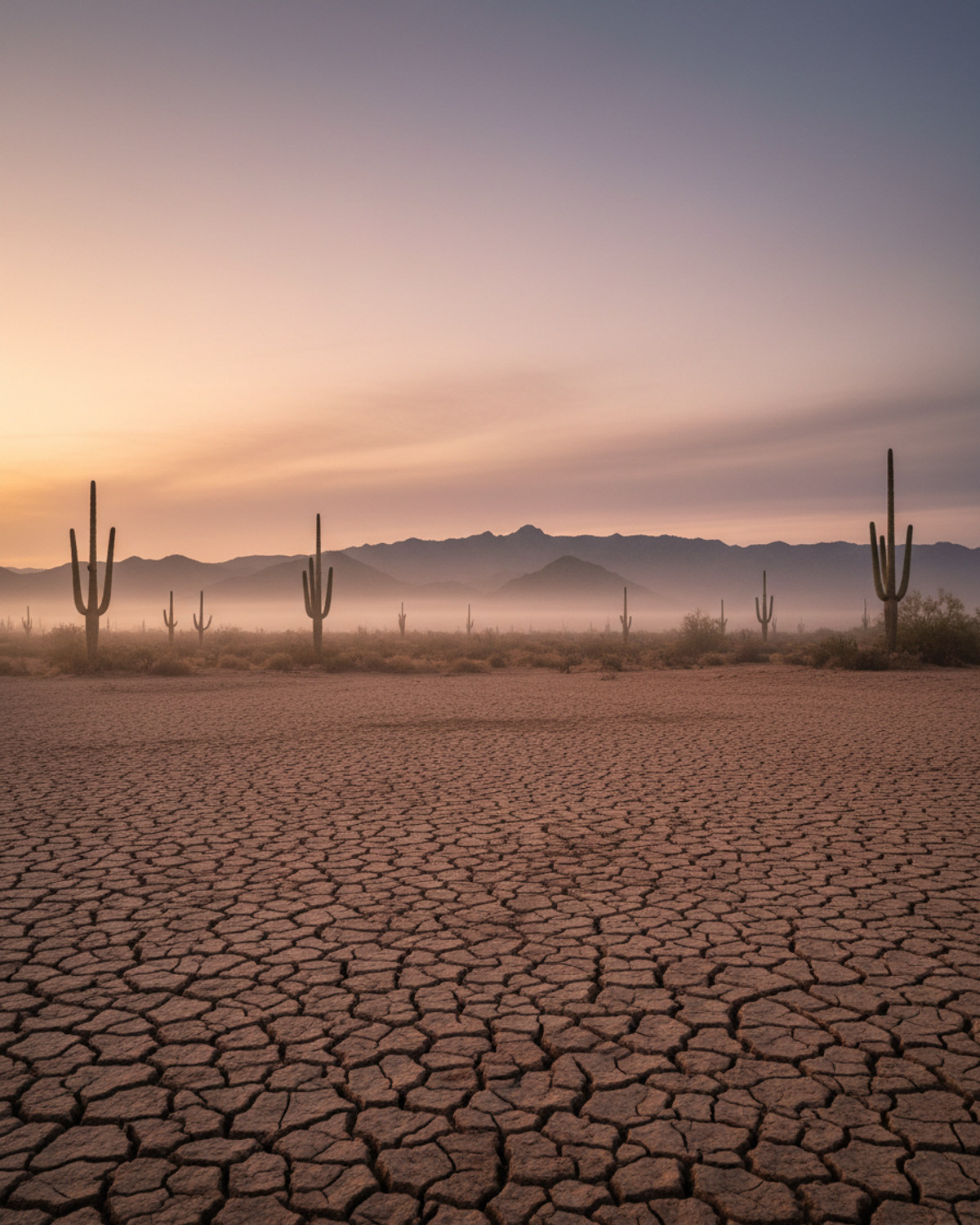
Phoenix logged just 1.41 inches of rain by early September, well under its 56-year average, and the shortfall left skin barriers without the mid-summer humidity buffer they usually count on before the dry season sets in.
A Monsoon That Came Up Short
Arizona's 2026 monsoon is closing out one of its driest showings in decades. Through September 3, Phoenix had logged just 1.41 inches of rain across 10 wet days this season, well under the pace of a normal year, which usually sits closer to 1.9 inches by that date, and far under the 56-year seasonal average of 2.56 inches. Mid-August was worse: only 0.65 inches had fallen by then, a stretch so dry that, according to National Weather Service records cited in the same rainfall analysis, only 1921 had less rain on the books by that point in the season. A run of late-August storms pulled the city back from record-dry territory into merely below-normal, but the shortfall never fully closed.
That matters for skin because Phoenix's monsoon usually functions as a brief humidity intermission in an otherwise arid year. In a below-normal season, that intermission barely happened.
What September 30 Actually Changes
Arizona's monsoon is a defined window, not a vibe: the City of Phoenix marks it as running from June 15 to September 30, with storm activity typically peaking between mid-July and mid-August. Once the calendar clears September 30, the occasional afternoon storm cell that has been recharging outdoor moisture stops showing up on the forecast, and the valley heads into its long dry season.
September itself is already a low-humidity month by local standards. Average relative humidity for the month runs around 36 percent, but it swings hard within a single day: readings near 50 percent in the early morning typically fall to about 23 percent by late afternoon. That afternoon number is the one worth paying attention to, since it lines up with the hours most people are outdoors, commuting, or running errands.
The Range Dermatology Research Keeps Coming Back To
A widely cited 2016 review in the Journal of the European Academy of Dermatology and Venereology pulled together decades of human studies on ambient humidity and skin barrier function. Its conclusion: relative humidity below roughly the 40 to 60 percent band is associated with higher transepidermal water loss, along with stiffening and micro-cracking of the stratum corneum, the outermost layer of skin that holds moisture in.
Phoenix's afternoon September humidity of about 23 percent sits nearly 20 points under the low end of that range. That gap is the practical reason skin can start to feel tight, flaky, or rough by late in the day even when nothing about a routine has changed.
Why the Effect Doesn't Always Show Up the Way You'd Expect
The relationship between humidity and measured water loss is not perfectly linear, and it's worth being precise about that rather than overstating it. A 2005 study in Archives of Dermatological Research followed workers with occupational exposure to an ultra-low-humidity environment (relative humidity around 1.5 percent) for shifts lasting up to 12 hours. Transepidermal water loss readings in the exposed group were actually lower than in a control group (8.3 versus 10.0 grams per square meter per hour), while skin capacitance, a separate hydration measure, showed no statistically significant difference between groups.
The researchers' interpretation was that barrier adaptation under sustained extreme dryness is more complicated than a simple more water loss equation, and that different measurement methods can tell different parts of the story. The takeaway for a Phoenix reader isn't that dry air is harmless. It's that a single number on a hygrometer doesn't fully capture what's happening to skin, which is one reason product marketing that leans on a single lab metric deserves a second look.
What Changes Underneath the Surface
A study published in February 2026 in Clinical, Cosmetic and Investigational Dermatology took a more mechanistic angle, exposing mice to 15 percent relative humidity for six months against a 55 percent humidity control group. Low humidity exposure downregulated 159 genes and upregulated 105, with the upregulated set concentrated in keratinization pathways alongside increased IL-17 and TNF inflammatory signaling.
A topical emollient partially reversed the pattern, shifting gene expression toward fatty acid elongation and PPAR-related lipid metabolism pathways while damping the inflammatory signals. Translated out of the lab: sustained dry-air exposure appears to push skin cells toward a defensive, inflammation-leaning state, and replacing lost surface lipids can shift that balance back, at least partially.
Why This Year's Timing Compounds the Problem
A typical Phoenix summer gives skin a rough rhythm to adapt to: brutally dry May and June, a humidity bump once the monsoon storms arrive in July and August, then a slide back toward dry conditions as the season winds down. This year, with rainfall running roughly 45 percent below the 56-year average through early September, that mid-summer bump was smaller and later than usual. Skin barriers that would normally get a few weeks of partial recovery went into the September dry-down already behind.
None of this is unique to any one person's skin type. It's a regional atmospheric pattern intersecting with a well-documented physiological response, and both halves of that are backed by the sources above rather than a marketing claim.
A Practical Routine for the Switch-Over
A few concrete adjustments line up with what the research above actually measured, rather than general skincare advice:
- Apply a richer emollient within a couple of minutes of washing your face, while skin is still damp, so it has surface water to lock in rather than trying to add moisture back later.
- Layer an occlusive ingredient, such as petrolatum or squalane, over a humectant like glycerin or hyaluronic acid instead of using either alone; the gene-expression research above points specifically to lipid-replacement as the mechanism that helps.
- If you run a humidifier at home, late night through early morning is when it can do the most good, since that's when Phoenix's own humidity is at its daily peak and easiest to hold onto indoors.
- Treat the 2 p.m. to 6 p.m. window as the highest-risk stretch for moisture loss outdoors, matching the daily humidity low, and reapply a hand or face balm if you're out in it for extended periods.
- If a routine that worked fine in July suddenly feels like it's not enough in September, that's consistent with the data here, not a sign your skin changed for no reason. Consider simplifying actives temporarily and prioritizing barrier-supporting ingredients until humidity stabilizes.
The monsoon's shortfall is now baked into the record. What happens next, as the season officially ends this month, is a drier stretch than usual landing on skin that didn't get its usual head start.