Winter particle advisories arrive in Phoenix just as the air is at its driest. Here is what lab research does and does not show about particles and the skin barrier, plus a simple routine.
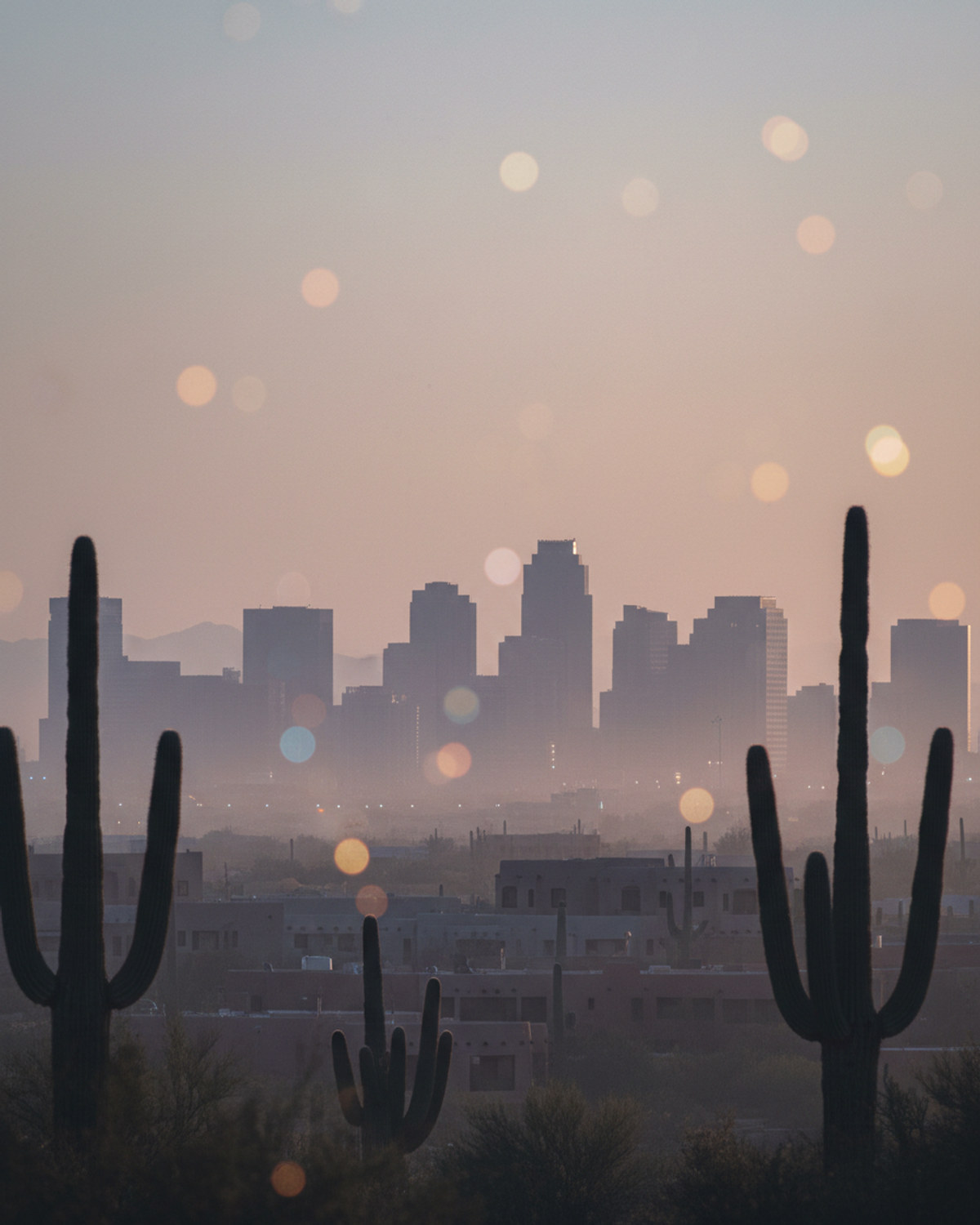
Phoenix is flagging poor air quality this week, and the timing is familiar. In the Valley, the cooler months bring a different kind of bad-air day than summer's ozone: fine particles that settle in when evenings get calm and cold. For skin, the interesting wrinkle is that Phoenix pairs those particle-heavy days with famously dry air. This guide separates what the research shows from what it does not, then gives a simple routine for those days.
Why Phoenix air gets bad as the weather cools
Arizona's air agency issued a high pollution advisory for metro Phoenix on November 29, 2024, warning that fine particulate matter (PM2.5) was expected to exceed federal health standards. The agency's meteorologist tied it to holiday fires plus calm, cool, stagnant weather that was expected to last several days. A year later, Maricopa County declared No Burn Days in mid-December 2025, banning wood burning in residential fireplaces, chimeneas and outdoor fire pits. A local meteorologist pointed to temperature inversions, which trap cold air and pollution at the surface, as one reason winter air quality suffers.
The practical point: in this region, the poor-air season often starts around now and peaks around the holidays. Check the state's Phoenix forecast page each morning rather than relying on how the sky looks.
What the skin research actually shows
The best-known study on particles and the skin barrier is a 2021 paper in JCI Insight. Researchers exposed lab-grown skin and hairless mice to PM2.5 collected in Seoul. In the lab-grown skin, exposure raised transepidermal water loss (TEWL), a measure of how quickly water escapes through the skin. In mice, TEWL was higher after 10 days of twice-daily exposure. The team also saw reduced filaggrin, a protein involved in forming the skin's natural moisturizing factors.
Now the limits, which matter as much as the headline:
- The human part involved just five people sampled before and after moving from Denver to Seoul. Humidity, temperature and UV differed between the cities and were not controlled.
- The mice were hairless, healthy and treated with a particle suspension applied directly to the skin, which is not the same as breathing city air.
- It shows an association and a plausible mechanism, not proof that a given smoggy day changes your skin.
So the fair summary is: lab and animal work suggest fine particles can stress the barrier, and human evidence is thin. That is a reason for a gentle, barrier-focused routine, not for alarm.
Phoenix's dry air is the second half of the story
A board-certified dermatologist writing for Valleywise Health notes that low humidity dries out the skin's outer layer, and recommends reapplying moisturizer during the day if skin feels drier than usual. The same guide suggests keeping things simple: a good moisturizer and a broad-spectrum sunscreen of at least SPF 30, with SPF 50 described as ideal, plus exfoliating sparingly because over-exfoliation can compromise the barrier.
That combination is the key for a poor-air day in the desert: particles on one side, dry air on the other. Both reward a routine that is gentle and that holds water in.
A gentle routine for a poor-air Phoenix day
- Cleanse once at night with a mild, non-foaming or low-foaming cleanser. The goal is to rinse off particles and sunscreen, not to strip. Lukewarm water, not hot.
- Skip scrubs and strong acids on advisory days. The Valleywise guidance on sparing exfoliation applies doubly when the barrier may already be working hard.
- Moisturize on damp skin. Apply within a few minutes of washing, and reapply midday if skin feels tight.
- Choose a cream over a thin lotion. Creams carry more occlusive and lipid ingredients that slow water loss.
- Wear sunscreen anyway. Phoenix UV does not take the winter off, and an SPF 30 or higher product is the baseline in the dermatologist's guidance.
What about ceramides?
Ceramides are a natural part of the lipid matrix between skin cells that holds water in. A 2021 qualitative review in the Journal of Dermatology looked at 12 controlled trials of ceramide-containing preparations, mostly in people with barrier-related skin conditions. Ceramide products performed equal to or better than comparators such as petrolatum or a plain base cream, and some trials reported lower TEWL and improved hydration.
The caveats: the studies differed too much to combine statistically, many were small, the types of ceramides were often unclear, and the review does not address humidity at all. The authors themselves say a large double-blind comparison is still needed. A ceramide cream is a reasonable, well-tolerated pick for a dry climate, but the evidence does not show it blocks anything particles do. Treat it as a moisturizing choice, not a shield.
Indoors, outdoors and what not to burn
Because wood smoke is a heavy contributor on bad days, the simplest skin-friendly step may be outside the bathroom. On No Burn Days, the county restrictions mean skipping the fireplace and fire pit, and the county notes residents may be eligible for up to $2,000 toward converting a wood-burning fireplace to gas. The state's advisory guidance for sensitive people was to stay indoors or limit time outside and to reduce exertion if outdoors. Less time outdoors means less exposure for everyone, skin included.
The takeaway
On a poor-air day in Phoenix:
- Check the morning air forecast and plan outdoor exercise for a better-air window.
- Cleanse gently once at night, then moisturize on damp skin; reapply a cream midday if skin feels tight.
- Pause scrubs and strong exfoliating acids until air clears.
- Keep daily sunscreen at SPF 30 or higher.
- Do not burn wood on advisory days.
The research here is early and mostly lab-based, so keep expectations modest: this routine supports the look and comfort of dry, stressed skin, and it costs almost nothing to try.