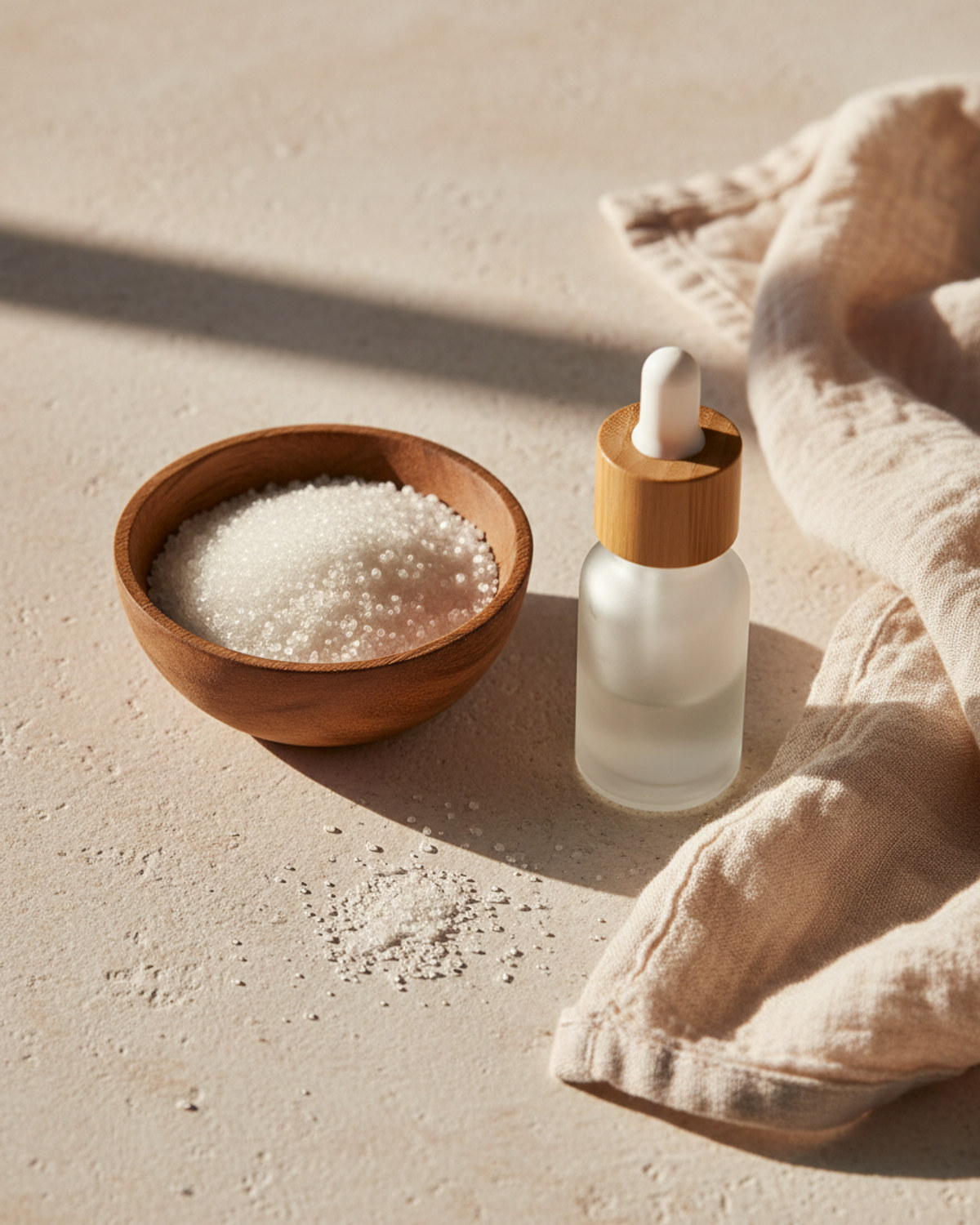
The microtear warning about scrubs has no reliable source, and acids are not automatically gentler. Here is what a few small studies and a regulatory FAQ do and do not show.
Choosing between a gritty scrub and an acid exfoliant is one of the most common routine questions, and it is surrounded by confident claims. Scrubs 'tear' skin. Acids are 'gentler'. Neither statement holds up well when you look for the data. This guide separates what is documented from what is repeated, and gives a practical way to decide.
Two ways to remove surface buildup
Physical exfoliation uses friction: grains, brushes, cloths or tools that lift away loose surface cells. Chemical exfoliation uses acids to loosen the bonds between those cells so they shed more easily. Both change how the surface looks and feels, and both can be overdone.
The first thing to know is how little head-to-head research exists. Searches for trials comparing a facial scrub with an acid exfoliant on barrier measures turn up almost nothing, so most advice you read is reasoning from principles, not from outcomes.
The microtear claim is weaker than it sounds
A popular line says rough particles such as crushed apricot kernels cause microscopic tears in skin. Michelle Wong, a chemist who writes the Lab Muffin Beauty Science blog, reported in 2015 that she could not find a reliable source for that claim, or for the idea that such tears harbor bacteria. That post cites no peer-reviewed trials, and it rests on her reading of the literature and on practical experience, so it is a reasoned opinion, not a study.
The same post makes a more modest and probably more useful point: harshness depends on particle size, hardness and smoothness, and on how you apply the product. Light, small circular rubbing for a minute or two is described as both more effective and less irritating than brief, hard rubbing. In other words, technique and frequency matter more than the category label.
What one small trial measured
An older study offers a rare direct look at a scrub. In a split-leg comparison, 12 elderly women with dry, itchy lower legs used an aluminum oxide scrub cream combined with an alpha hydroxy acid formulation on one leg and the acid formulation alone on the other for 3 weeks. Both approaches significantly reduced transepidermal water loss, which the authors read as improved barrier function, and the reduction was greater with the acid alone. Hydration did not change with either.
Take that with plenty of salt. It involved 12 people, leg skin and not facial skin, and a scrub that was paired with an acid, so it shows only that adding a scrub did not outperform the acid on that measure.
Acids are not automatically gentle
A 2022 randomized trial in Chinese Medical Journal compared two glycolic acid approaches in 80 adults with mild to moderate facial blemishes: a 5% glycolic acid complex applied daily and a 20% glycolic acid peel given in four sessions two weeks apart. Transepidermal water loss rose in both groups, but more with 20% (a mean change of 6.52 versus 2.43 g per square meter per hour). Hydration increased significantly only with the 5% complex, which also included repairing ingredients. The 20% peel showed greater improvement in the look of pores.
Adverse effects were reported by five people in the 5% group and eight in the 20% group, a difference that was not significant. The authors noted the study was single-center, had no control group and might not generalize. The lesson is that concentration and formula shape the outcome, and that an acid is not guaranteed to be gentler than a scrub.
Where regulation fits in
In the US, the Microbead-Free Waters Act of 2015 prohibits manufacturing, packaging and distribution of rinse-off cosmetics that contain plastic microbeads, defined as solid plastic particles of 5 millimeters or less intended to exfoliate or cleanse. The deadlines were July 1, 2017 for manufacturing and July 1, 2018 for introduction into interstate commerce for most rinse-off cosmetics, with a year added for products that are also non-prescription drugs. The FDA notes the law does not address consumer safety. So the rule is about plastic pollution, and it says nothing about whether sugar, salt or ground seed scrubs are better or worse for skin.
A practical way to decide
- Match the product to the area and the skin you have. Thicker, resilient areas such as elbows and heels tolerate friction better than the face.
- Pick one exfoliation method at a time. Combining a scrub with an acid in the same session adds irritation risk without evidence of added benefit.
- Start once a week. Increase only if skin looks and feels comfortable the next day. Tightness, stinging or a shiny, tight surface are signs to pause.
- Use light pressure and short time if you choose a scrub, about one to two minutes with small circles.
- Choose lower concentrations first if you choose an acid, since higher strengths raised water loss in the glycolic acid trial.
- Moisturize and wear sunscreen. Exfoliating leaves the surface more exposed, so daily broad-spectrum protection matters.
The takeaway
The evidence does not crown a winner between scrubs and acids. The microtear warning lacks a reliable source, while the idea that acids are always milder is not supported by the glycolic acid data. Decide by area, strength, frequency and how your skin responds, keep to one method per session, and regard comfort the next day as your most reliable measure.