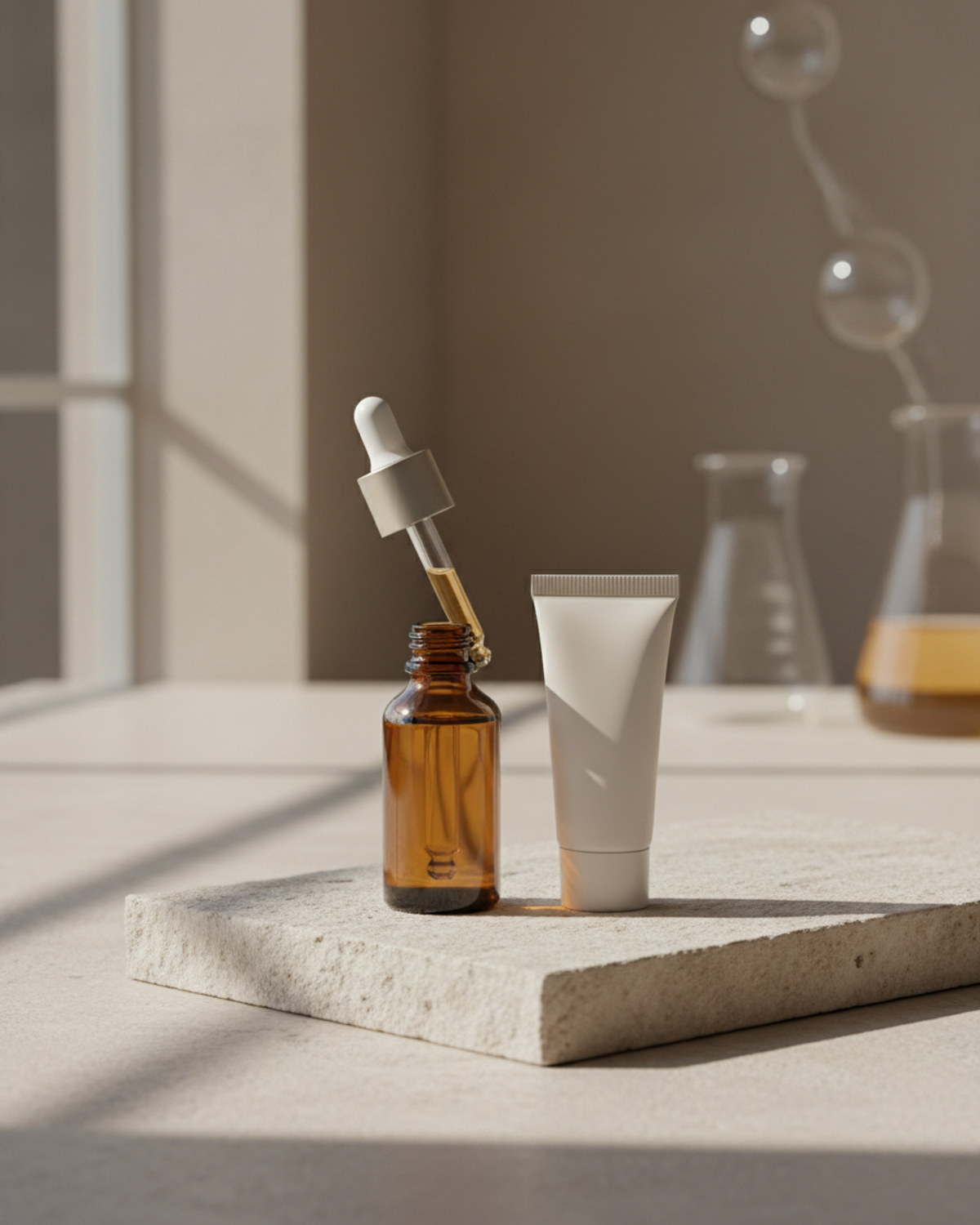
No trial pits retinol cream against serum. Here is what published research does show about strength, stability and a gentle ramp-up for a cosmetic routine.
Search interest in retinol cream, retinol serum and retinol lotion keeps climbing, and the question underneath is usually the same: which texture is better? The honest answer from published research is that nobody has run a clean head-to-head of cream against serum. What the literature does cover is how much retinol is in the bottle, whether it survives until you use it, and how gently you ramp up. Those three factors matter more than the word on the front label.
What the research actually tested
The best-known head-to-head trial was a 12-week, randomized, double-blind, split-face study of 72 enrolled women aged 41 to 65 with moderate to severe facial photodamage. One side of the face got a retinol lotion at 0.25%, 0.5% or 1.0%; the other got a tretinoin cream at 0.025%, 0.05% or 0.1%. By weeks 8 and 12, all three retinol products showed significant improvement in the look of fine lines, coarse lines, tone brightness, mottled pigmentation and roughness, with no significant difference from the paired tretinoin product.
Two caveats matter. The study was funded by the manufacturer, and its authors included company employees. And the test products were lotions and serums, not a cream-versus-serum comparison. A 2022 review of retinoid trials made a similar point: retinol studies are often small, often lack a vehicle control, and retinol should not automatically be treated as equivalent to prescription tretinoin.
Texture is a delivery choice, not a strength setting
Serums tend to be thinner and creams tend to carry more emollients, but a lighter feel does not tell you how much retinol is inside. The 2022 review does not directly compare vehicles for the same retinoid, and it notes that stability depends on the specific formulation, to be judged case by case. Treat claims that a serum is automatically stronger, or a cream automatically gentler, as brand marketing rather than settled science.
What texture can reasonably change is how the product feels and how it fits your routine. A richer cream may suit skin that looks dry or tight in cooler weather. A lighter serum may layer more easily under moisturizer and sunscreen. Choose the one you will actually apply consistently at a low frequency.
Strength: lower than the label hype suggests
Over-the-counter labels often do not disclose the retinol percentage, and a dermatologist quoted by the American Academy of Dermatology (AAD) recommends choosing the lowest strength available. The 2022 review reports that retinol concentrations from 0.075% to 0.5% have been tested against vehicle, with some trials showing significant improvement and others not, and it describes 0.3% as the maximum recommended cosmetic concentration. It also ranks tolerance as roughly retinyl esters, then retinol and retinaldehyde, then tretinoin as the most irritating, with retinol about tenfold less potent than tretinoin.
In practice, that means a modest percentage used consistently has the strongest published support for a cosmetic routine. A bigger number mostly raises the odds of visible dryness and redness.
Stability: the quiet variable
Retinol is sensitive to light, oxygen, heat and heavy metals. The 2022 review estimates that retinol in cosmetics is generally stable for under 6 months even when made under an inert atmosphere and kept in aluminum tubes at 20 degrees C or below, conditions most products do not meet. It also cites a study of 12 commercial retinoid products that found instability in almost all of them during long-term and accelerated testing, and another of 35 products that found content deviating from declared amounts.
So packaging is a practical signal. Look for opaque tubes or airless pumps rather than clear jars you open daily, keep the product away from a sunny or steamy windowsill, and replace it if the color or smell changes. Encapsulated or nanoformulated retinol is a promising idea, but the review says clinical studies of those formulations are lacking.
Ramp up the way dermatologists suggest
The AAD page quotes dermatologist Tina Alster advising people to start with the mildest retinoid available, apply it every other night, and increase gradually; she notes that people who skip this step often irritate their skin. The same page says to use retinoids only at night because they increase sun sensitivity, to wear daily sun protection, and to use a moisturizer to help limit irritation. It adds that irritation can lead to dark marks, especially in darker skin, and that retinoids should not be used during pregnancy; talk to your doctor about products during pregnancy. The page was last updated in 2021, so it is worth checking for newer guidance.
In the split-face trial, redness, dryness and stinging scores rose by week 4 but stayed mild or below, and no tolerability measure showed a significant increase by week 12. Early flaking is common; it is a cue to slow down, not speed up.
Cushioning irritation: what a small 2025 test found
A 2025 patch test of 21 healthy adults compared 15 soothing or barrier-supporting ingredients added to a 0.1% retinol serum over 5 days. Several, including 5% ceramides, 2% panthenol and 0.5% Centella asiatica, were grouped as good benefit, meaning no Grade 2 reactions, while bisabolol did not differ from the plain retinol vehicle. The study was small, short, and funded by a cosmetics company whose employees wrote it, and the authors themselves called for larger trials. Still, it supports a modest idea: a ceramide-containing moisturizer layered with retinol is a reasonable, low-risk habit.
A practical plan
- Pick a low strength. If the label lists a percentage, start at the low end; if it does not, assume the lowest-strength product in the range.
- Choose texture by skin feel. Cream if your skin looks dry, serum if you prefer a light layer. Neither is proven stronger.
- Check the packaging. Opaque, airtight, and used up within a few months of opening.
- Start every other night, at night only, with a pea-sized amount for the face.
- Moisturize and use daily sunscreen. A physical sunscreen with zinc oxide or titanium dioxide is the AAD's suggestion for sensitive skin.
- Judge at 12 weeks, the length of the main trial, not at week 2.
The takeaway: cream versus serum is a preference. Strength, fresh and well-protected product, and a slow ramp-up are the choices the research can actually speak to.