If your morning moisturizer is gone by 3 p.m., the culprit may be formula balance, dry indoor air or shower habits rather than too little cream. Here is how to rebuild the routine.
It is a common complaint heading into the heating season: you moisturize in the morning, and by mid-afternoon your skin feels tight again. The usual advice is to buy a richer cream. The research on how moisturizers are built suggests the real problem is often how the formula is balanced and how the day is structured, not how thick the jar looks. Here is how to work out why skin feels dry by afternoon, and a practical way to fix the routine without piling on more products.
Start with what a moisturizer is made of
Dermatology reviews sort moisturizer ingredients into three jobs. Humectants attract water. Occlusives form a hydrophobic layer that slows water loss. Emollients are mainly lipids and oils that improve softness, flexibility and smoothness. Most products blend all three, and the proportions decide how the product feels at hour six, not hour one.
A review in the Indian Journal of Dermatology calls glycerol the most effective humectant. The same review explains the catch: humectants pull water from two sources, the dermis and, in humid conditions, the surrounding air. Because they can increase transepidermal water loss by drawing water up from deeper layers, they are mostly combined with occlusives. In other words, a humectant-only serum can feel wonderful for an hour and then leave you feeling drier if nothing seals it in.
The occlusive numbers worth knowing
The same review reports that petrolatum, at a minimum concentration of 5 percent, reduces transepidermal water loss by more than 98 percent, and that its water vapor loss resistance is about 170 times that of olive oil. Lanolin, mineral oil and silicones reduced water loss by roughly 20 to 30 percent in the review's comparison. Those are laboratory comparisons, not a promise about how your face will look at 3 p.m., but they explain why a cream with a real occlusive layer tends to outlast a watery gel.
The American Academy of Dermatology's list of ingredients to look for in creams and ointments includes glycerin, hyaluronic acid, dimethicone, petrolatum, shea butter, mineral oil and lanolin, a mix of humectants, emollients and occlusives that mirrors the three-job framework.
Your room may be the third variable
Indoor air in heating season can be strikingly dry. In a study of eleven volunteers aged 80 and over in a Scottish care home, average bedroom relative humidity fell below 40 percent, under the minimum winter level recommended by the CIBSE building guide. Skin surface hydration, measured in the stratum corneum, correlated significantly with room absolute humidity. The sample is small and older, so it will not map neatly onto every adult, but it supports a simple idea: the air around you is part of your hydration routine.
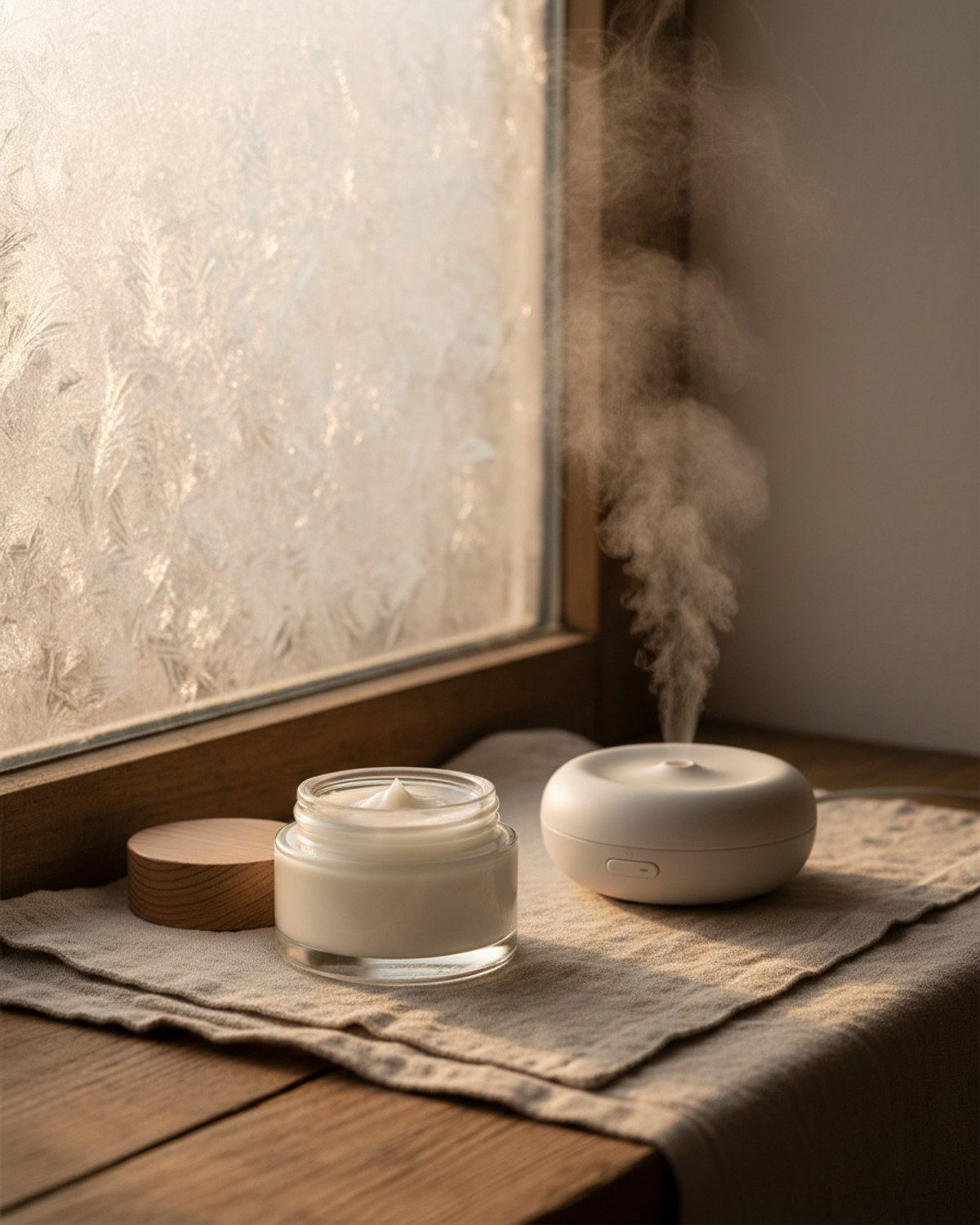
The AAD suggests adding humidity with a whole-home or portable humidifier, placing a portable unit in the bedroom overnight, and cleaning it regularly to prevent mold.
Check your shower before your serum
Hydration can be undone before the first product goes on. The AAD recommends keeping showers and baths to 5 to 10 minutes in warm rather than hot water, closing the bathroom door to hold moisture in, and patting skin dry rather than rubbing. It also suggests a gentle cleanser in small amounts, only where needed.
Timing matters as much as texture
Both the AAD and the occlusive research point to the same trick: apply on damp skin. The AAD says to moisturize while skin is still damp after a shower or bath, after washing hands, and whenever skin feels dry, and to apply it several times a day. The review adds that occlusives work best on slightly dampened skin. A two-step version looks like this:
- After cleansing, leave skin slightly damp, not dripping.
- Apply a glycerin or hyaluronic acid based product first if you like one.
- Seal with a cream or ointment containing an occlusive such as petrolatum or dimethicone.
- Repeat a thin layer of the cream on the driest zones in the afternoon instead of redoing everything.
Fragrance and unscented labels
The AAD advises choosing products labeled fragrance-free and steering clear of ones labeled unscented, because unscented products may contain masking chemicals that can irritate dry skin. If skin feels both tight and stinging, simplify before you add anything new. Alcohol-heavy toners and active products like retinoids are also on the AAD's avoid list when skin is very dry.
A one-week reset you can try
- Days 1 to 2: Shorten showers to 10 minutes or less, drop the water temperature a notch, and pat dry.
- Days 3 to 4: Switch to a fragrance-free cream or ointment rather than a lotion, since the AAD says creams and ointments add more moisture.
- Days 5 to 7: Add a bedroom humidifier overnight and a small afternoon top-up on the driest areas.
Keep notes on how your skin looks and feels at about 3 p.m. each day. If tightness persists despite these steps, the AAD recommends seeing a board-certified dermatologist.
The takeaway
Afternoon dryness is rarely about one missing ingredient. It is usually a balance problem: water attracted by humectants, held in by an occlusive, in a room with enough humidity, after a shower that did not strip the surface. Fix the sequence first, then judge the product.