Marine-sponge spicules are the newest K-beauty ingredient promising microneedling results without the needles. Here is what the depth numbers actually show, and who dermatologists say should skip them.
Serums studded with microscopic, needle-shaped particles have become one of the fastest-moving trends out of the K-beauty pipeline this year, marketed under a single pitch: microneedling in a bottle. The particles are called spicules, and the claim is bold enough that it is worth checking against what these structures actually are, how deep they go, and who dermatologists say should leave the bottle on the shelf.
What Spicules Actually Are
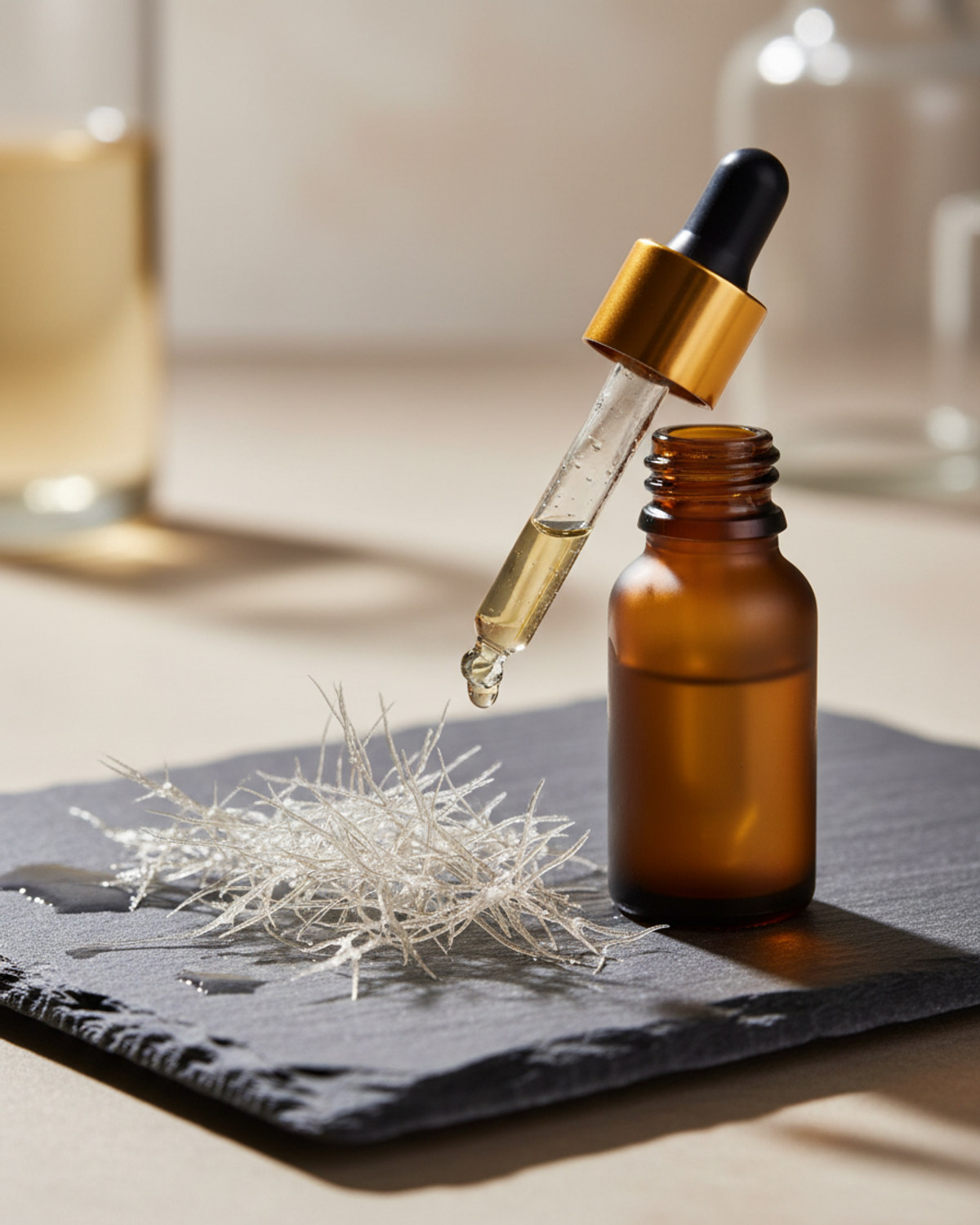
Spicules are microscopic, needle-like structures that occur naturally as the internal skeleton of marine and freshwater sponges, most commonly made of silica [1]. Manufacturers harvest them from controlled-environment sponge cultivation, then purify the material with fermentation enzymes or acids to strip away organic tissue before grinding it into the fine powder suspended in serums, ampoules, and exfoliating masks [1][2]. Individual spicules run about 200 micrometers, roughly a fifth of a millimeter, small enough to be invisible but coarse enough to feel as a faint prickle when massaged into skin [2].
The Micro-Channel Mechanism
The appeal is mechanical, not chemical. When spicules are worked into the skin, they create thousands of shallow micro-injuries in the outermost layer, the stratum corneum, which trips the same wound-healing cascade that starts after a scrape [2]. Board-certified dermatologist Julie Russak has described the effect as opening microchannels in the stratum corneum that stay propped open for up to two days, long enough for serums applied afterward to absorb more efficiently than they would on intact skin [3]. Dermatologist Hadley King puts it more plainly: think of spicules as topical microneedles suspended in a serum or cream [3].
How Deep Spicules Really Reach
Here is where the bottle-versus-clinic comparison breaks down. Professional microneedling devices, the kind used in-office for scarring and texture, drive needles 2 to 3 millimeters into skin, reaching well into the dermis where collagen is actually produced [4]. Even at-home mechanical microneedling rollers only reach about 0.25 millimeters [4]. Spicules, at roughly 0.2 millimeters, sit in that same shallow at-home range and do not come close to the 2-to-3-millimeter depth of an in-office treatment. Cosmetic chemists quoted on the trend have been blunt that spicules are marketed as microneedling treatments in a bottle, but the comparison is misleading once the actual depth gap is laid out [1]. What spicules reliably do is boost penetration of whatever serum follows; what they do not do is replicate the deeper collagen stimulation of a clinical device.
What Dermatologists Are Telling Patients
None of the dermatologists interviewed across recent coverage dispute that spicules do something. Marie Jhin describes them as tiny physical stimulators that create micro-channels in skin, and the resulting mild exfoliation plus improved serum uptake is a real, if modest, benefit for otherwise resilient skin [3]. The disagreement is with the framing. Deborah Spey has pointed out that the marketing borrows the credibility of an in-office procedure for a product that behaves more like a textured exfoliant with a delivery boost, and that expecting spicule serums to match clinical results sets shoppers up for disappointment [2].
Who Should Sit This One Out
The caution list is consistent across sources. Spey advises against spicules for anyone with sensitized, redness-prone, or reactive skin, or for skin currently showing signs of breakouts, since the micro-injuries can aggravate an already irritated surface [2]. She also tells patients with a compromised or visibly damaged barrier to wait until that barrier has settled before introducing any mechanical exfoliant, spicules included [2]. Coverage in Women's Health raises one further, more specific concern: because spicules are foreign material worked into skin, there is a theoretical risk of a foreign body granuloma, an immune reaction to material the body cannot break down [1]. Dermatologists interviewed there believe the risk from over-the-counter spicule formulas is minimal precisely because the particles sit so shallow and shed naturally within days, but they still flag it as a reason to avoid daily use or aggressive rubbing [1][3]. Anyone who is pregnant is advised to raise spicule use with their doctor before adding it to a routine, the same caution that applies to most active exfoliants [2].
Ingredients to Keep Away From Spicule Serums
Both Spey and the chemists quoted alongside her agree on one formulation rule: do not layer spicules with retinoids or chemical exfoliants such as glycolic or salicylic acid on the same night [2]. The micro-channels that make serum absorption more efficient also make the skin more permeable to irritants, so stacking a physical spicule treatment with a strong chemical active in the same routine compounds the irritation risk rather than the benefit. The safer sequencing is to treat spicules as their own step on a night set aside for them, with a plain, barrier-supportive moisturizer layered on top rather than another active.
A Realistic Way to Introduce Them
The cadence recommended across sources is conservative and incremental. Start at twice a week, gently massaging the serum in rather than scrubbing, and watch for the following day's response before adding a third session [1]. Spey suggests that skin which tolerates spicules well can build toward daily use after four to six weeks, though she is clear that daily use is not necessary for most people to see a benefit [2]. Anyone new to the category should patch test on a small area first and hold off on other actives, including sunscreen reapplication routines that involve rubbing, until the micro-channels have closed.
The Takeaway
Spicules are a real mechanical exfoliant with a genuine, if narrow, delivery-boosting effect, not a bottled version of an in-office procedure. The depth math is the whole story: about 0.2 millimeters from a jar versus 2 to 3 millimeters from a professional device is not a marginal difference, it is an order of magnitude. Treat spicule serums as a twice-weekly texture-and-absorption step, keep them off skin that is reactive, freshly compromised, or currently irritated, skip pairing them with retinoids or acids on the same night, and judge the product by what it visibly does to skin texture over a few weeks rather than by the phrase on the label.