Home LED masks and radiofrequency wands have small, short studies behind them. Here is how those trials were designed, what they measured, and how to judge a device claim.
Beauty devices are one of the most debated corners of skincare: LED masks, handheld radiofrequency wands and home lasers all promise salon-style results from a charging dock. The published research is more modest than the marketing, and it is also more specific. Here is what home-use device studies actually measured, how they were designed, and what that means before spending several hundred dollars.
Why device studies deserve a closer read
A cream can be tested against its own vehicle in a split-face design cheaply. Devices are harder to blind: the participant sees the light, feels the warmth, and knows which side was treated. Many published home-device studies are therefore small, short, and run by or for the maker. That does not make them worthless. It means the right question is not does it work but what exactly was measured, in whom, and for how long.
LED masks: small controlled evidence, modest endpoints
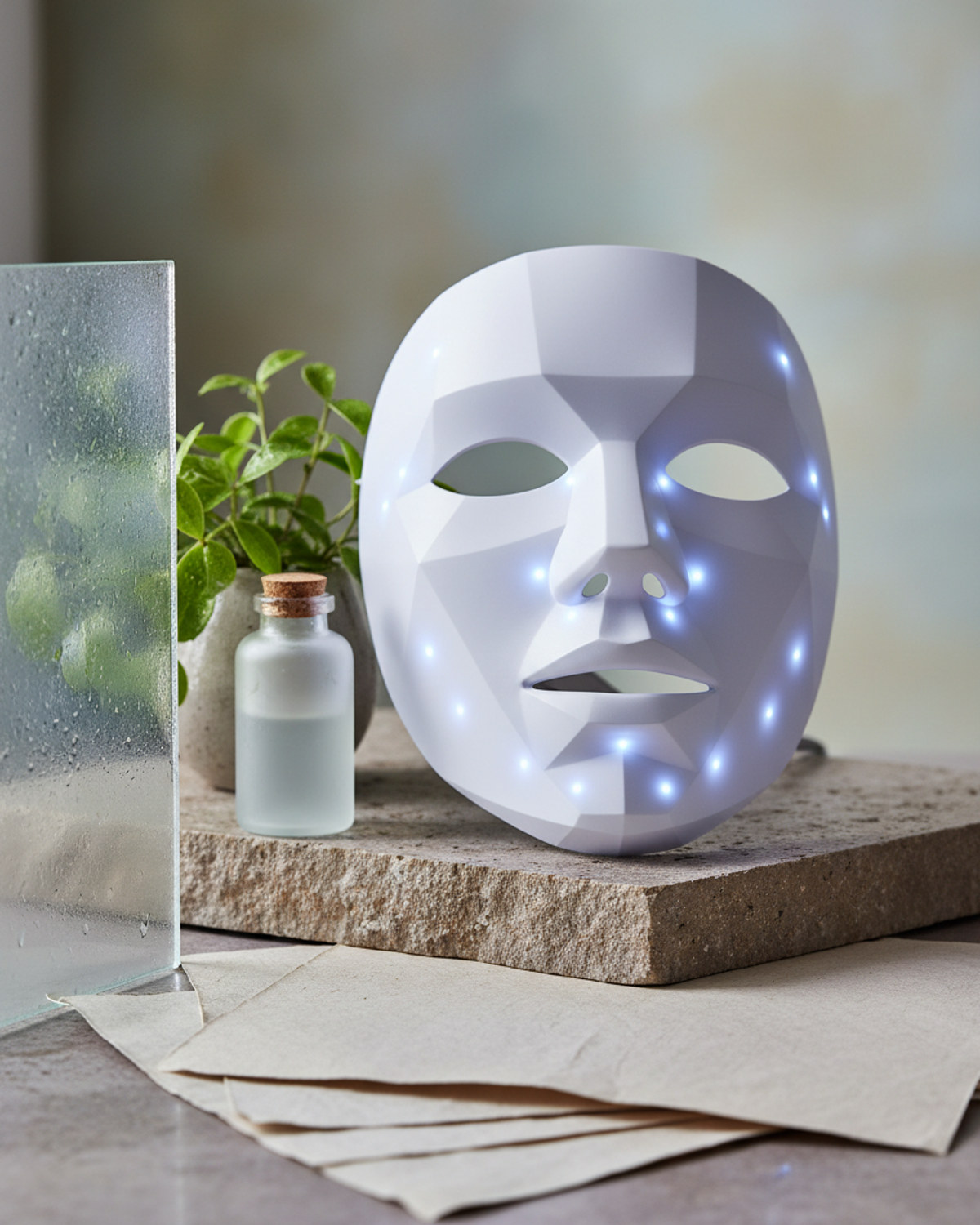
One split-face pilot tested a home-use LED device combining 637 and 854 nm light on 24 people with photoaged skin. The left side of each face was treated twice a week for 8 weeks, the other side served as control. Skin elasticity was significantly higher on the treated side at weeks 6 and 8, and image analysis showed improved texture at week 8.
A more recent exploratory study of a commercially available mask combining 630 and 850 nm LEDs, paired with a cream, enrolled 50 women aged 49-65. They used the mask 3-4 times per week and the cream daily for 56 days. Investigator scores showed progressive improvement from baseline, including -24.2% in crow's feet wrinkle depth and -39.4% in pore dilatation by day 56. The catch is the design: it compared participants with their own baseline, not with a sham mask, and it tested the mask and cream together, so it cannot say how much came from the light itself. An ex vivo part of the same paper used skin samples from six women.
Takeaway: for LED, there is some controlled evidence for the look of elasticity and texture after about two months of consistent use, and no evidence of a one-session effect.
Radiofrequency wands: one uncontrolled 12-week study
A 12-week study of a handheld multisource radiofrequency home device enrolled 47 people, who used it three times weekly for four weeks and twice weekly for eight more. Expert grading found improvements in the appearance of marionette lines, firmness, texture and tone, and instrument measures of elasticity improved too; only mild redness lasting up to 15 minutes was reported.
Again, the limit is the design. Like the mask study above, it was a single-arm study with no control group, so changes over time cannot be separated from moisturizer use, season or participants' expectations.
Skin tone changes the picture
Light-based devices depend on photons reaching their targets, and melanin absorbs light. A 2026 narrative review of photobiomodulation argues that melanin can reduce photon penetration in darker skin tones, that clinical protocols seldom account for this, and that few studies analyze results by pigmentation. For a shopper with deeper skin, that means a device's study population matters: check whether the trial reported skin tones, and be cautious about extrapolating from a small sample.
What the broader reviews say
A narrative review of photobiomodulation in dermatology covering the past six years describes the field as promising, with research on mechanisms (light interacting with cellular chromophores) and a mix of clinical trials and technology advances. Notice the language: promising and narrative, not definitive. Protocols, wavelengths and doses vary widely across studies, which makes it hard to say that one product's wavelengths will reproduce another's results.
A checklist for judging a device claim
- Look for a control. Split-face or sham-controlled beats before-and-after only.
- Check the duration. Most positive home-device results appeared at 6-8 weeks or later, not after a few sessions.
- Check who ran it. Industry-supported studies are common; they are not automatically wrong, but they deserve extra scrutiny.
- Match the wavelength and schedule. A product that does not share the tested wavelengths or frequency is not covered by that study.
- Ask about your skin tone. See whether participants like you were included.
- Compare cost to basics. Daily sunscreen and a well-tolerated moisturizer have broader evidence behind the look of skin than any single device.
Practical takeaway
If you already use sunscreen daily and a simple routine, a home LED device is a reasonable, low-irritation add-on to test, provided you commit to the schedules studied: roughly two to four sessions a week for eight weeks, with photos at the start, week 4 and week 8 in the same light. Keep expectations at the level the research supports: small, gradual changes in the look of texture and elasticity, not dramatic overnight results. If you have a skin condition, are taking photosensitizing medication, or are unsure whether a device suits your skin tone, ask your doctor before starting.