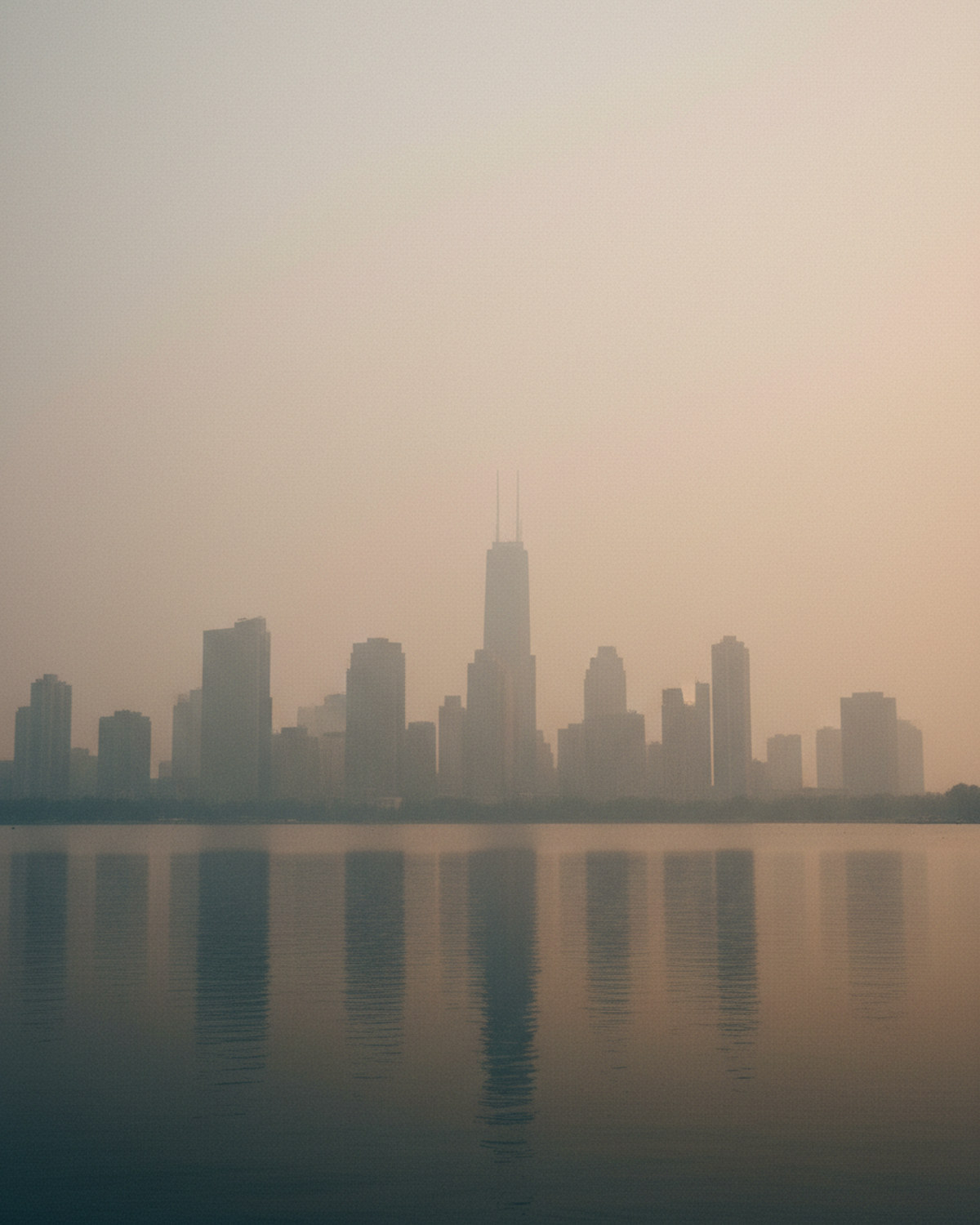
Chicago's air quality has ping-ponged between record-bad and merely moderate all summer, and it ticked back into poor territory again this week. The up-and-down pattern, not any single smoke event, is what actually wears down the skin barrier.
Chicago's air quality alerts stopped being an occasional headline months ago. The metro is again showing elevated fine-particle pollution this week, the same signal that pushed the city to the worst air quality of any major metro area on the planet for a stretch in mid-July [1]. What makes this summer different from a single bad-air day is the pattern: spikes, partial recoveries, and repeat spikes, over and over, since Canadian wildfire smoke first rolled into the Midwest.
A Summer of Air Quality Whiplash, Not One Bad Week
On July 17, Chicago's AQI reached 753, in the hazardous range and roughly three times the region's previous 30-year record of about 200 [1]. Beaches closed, outdoor park programs moved indoors, and O'Hare reported smoke-related visibility delays. By the morning of July 20, the reading had fallen to 153, still unhealthy for the general public, before easing further later that week [1]. Local meteorologists have been clear that any relief depends on wind direction, not a real end to the fire activity feeding it, since nearly 900 fires were still burning across Canada at the time [1]. That is why the city has cycled through moderate stretches and poor stretches multiple times since mid-July, including again now, rather than settling into one steady condition.
What Airborne Particulate Matter Actually Does to Skin
Fine particulate matter, commonly tracked as PM2.5, is small enough to work into hair follicles and past a compromised outer skin layer [2]. Once inside, it downregulates proteins the skin barrier depends on, including filaggrin, loricrin, and claudin-1, while increasing transepidermal water loss, which is a direct measure of how much moisture the skin is failing to hold onto [2]. Separately, the particles generate reactive oxygen species through redox-active metals and combustion byproducts, which then activate inflammatory signaling pathways inside skin cells [2]. Downstream, that oxidative cascade upregulates collagen-degrading enzymes tied to fine lines and activates melanin-producing pathways tied to uneven tone [2]. None of this requires visible soot on the skin. The damage is happening at a cellular level well before anyone notices anything on the surface.
Why Repeated Exposure Is Worse Than One Bad Week
A single smoke day is a stress test the skin barrier can usually absorb and recover from. The problem with this particular summer is the interval between episodes. Each spike triggers the same barrier-protein disruption and oxidative cascade described above, and if a new spike arrives before that repair process finishes, the cumulative effect compounds rather than resets [2]. That is the practical argument for treating this week's return to poor air quality as a continuation of the same exposure Chicago has been absorbing since mid-July, not an unrelated one-off event.
The Two Antioxidants With Actual Data Behind Them
Most pollution-defense marketing is vague, but two ingredients have specific published data against particulate matter damage. In laboratory testing on human skin cells, niacinamide blocked the reactive-oxygen-species surge triggered by PM2.5 exposure and reduced the resulting oxidation of lipids, proteins, and DNA inside those cells [3]. Separately, a 12-week randomized trial of a plant-derived antioxidant serum in 105 women living in a heavily polluted city measured real outcomes rather than lab proxies: participants using the antioxidant regimen showed improved skin brightness, reduced redness, and better-maintained barrier function and elasticity compared with the control group by the 84-day mark [4]. Neither ingredient blocks particulate matter from landing on skin. What the data supports is that they may help blunt the internal chemical cascade once it has.
Reading the AQI Number Before You Trust Your Gut
The AQI scale most US weather apps display runs from 0 to 500 across six color-coded bands. Readings of 0 to 50 are labeled good, 51 to 100 moderate, and 101 to 150 unhealthy for sensitive groups, meaning children, older adults, and people with existing cardiovascular or respiratory conditions face elevated risk even while the general public mostly does not [5]. Once a metro crosses 150, the general public itself is affected, and above 300 the scale reaches its hazardous, emergency-level top band [5]. The takeaway for a swing city like Chicago right now: a phone weather widget showing moderate does not mean the air has been fine, it means the air is fine at this specific hour, which can change by evening.
A Practical Routine for Swing Days
On any day the local reading crosses into the unhealthy-for-sensitive-groups band or higher, a double cleanse in the evening matters more than usual, since a single rinse tends to leave behind the fine particulate residue that settles on skin and hair over a smoky day. Layering a niacinamide serum underneath a barrier-supportive moisturizer, both morning and night, gives the skin two separate points of antioxidant and barrier reinforcement during a run of poor-air days rather than just one. Indoors, a HEPA filter running in the main living space measurably cuts the PM2.5 concentration skin and lungs are both exposed to, which matters most during exactly the multi-day stretches Chicago has now had several times since July. And checking the actual AQI number before deciding whether to exercise outside beats guessing from how the sky looks, since particulate levels can stay elevated on hazy-looking days that do not look dramatically smoky.
The specific number on any given day matters less than the pattern behind it. Chicago is not dealing with one bad air week this summer, it is dealing with a barrier that keeps getting knocked down before it fully recovers, and a skincare routine built for that reality looks different from one built for a single smoky afternoon.