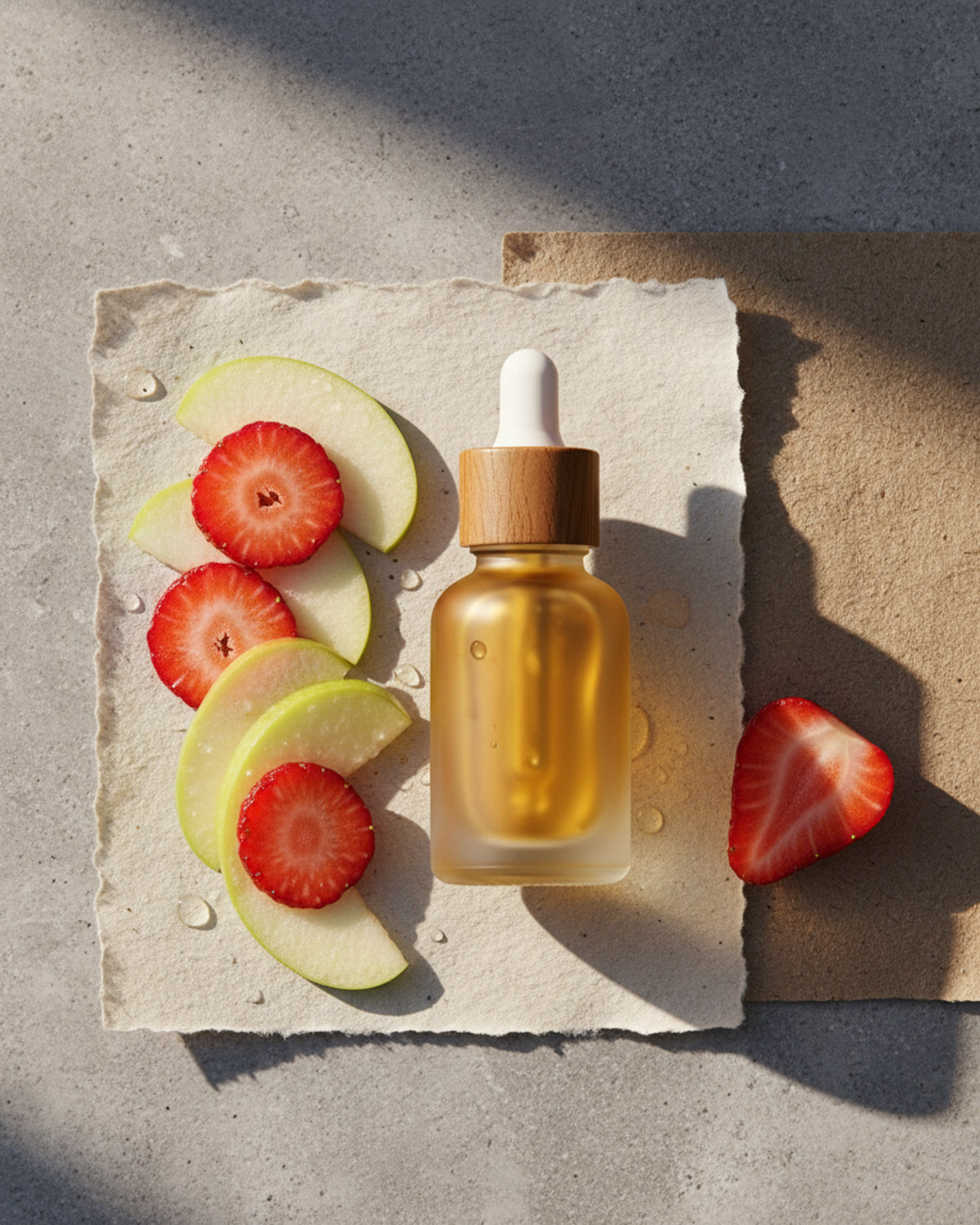
Fruit imagery covers two very different ingredient types. Here is how exfoliating acids and polyphenol-rich extracts differ, and what research supports for each.
Fruit is everywhere on skincare labels right now: strawberry gels, berry serums, apple extracts, and acids marketed as fruit acids. A recent Reddit thread asking whether fruit-based skincare is worth the hype shows how many people are unsure what the label is really promising. The honest answer depends on which kind of fruit ingredient you mean, because two very different things share the same marketing language.
Two different ingredients behind one label
The first group is the exfoliating acids, mainly glycolic and lactic acid. These are the alpha hydroxy acids (AHAs), and they work by encouraging the surface layer of skin to shed. Brands often describe them with fruit imagery, but the FDA page on AHAs does not characterize them as fruit-derived, and what matters for you is the concentration, the product pH, and the sun precautions, not the story on the box.
The second group is fruit and plant extracts, usually rich in polyphenols. These are plant compounds with antioxidant, anti-inflammatory, and antimicrobial activity in laboratory settings; green tea and grape seed are well-known examples. They are used in cosmetics for their potential support of the appearance of aging skin. These two groups behave differently, carry different risks, and have very different amounts of evidence behind them.
What the evidence says about fruit acids
The FDA summarizes the industry-run Cosmetic Ingredient Review panel's conclusion: glycolic and lactic acid products were found safe for consumers when the AHA concentration is 10% or less, the final product pH is 3.5 or higher, and the product either protects against increased sun sensitivity or directs daily sun protection.
The sun point is the one people miss. In studies the FDA cites, volunteers' skin reddening sensitivity to UV rose 18% after four weeks of using an AHA cream, and sensitivity to UV-induced cellular damage roughly doubled on average. The effect was reversible and faded within about a week after stopping. The practical rule from the same page: use sunscreen, wear protective clothing, and limit sun exposure during use and for a week afterward.
What the evidence says about fruit extracts
Here the picture is thinner. A 2015 review in the International Journal of Cosmetic Science summarized polyphenols for anti-aging uses, drawing mostly on in vitro work with skin cell lines that measured antioxidant activity, inhibition of dermal enzymes, and photoprotective activity. The authors also discussed possible negative effects, how emulsifiers can interact with polyphenols, and how the formulation changes delivery into skin. Importantly, they reviewed only a few clinical studies on topical use.
A 2020 editorial introducing a special issue on natural skincare compounds makes a similar point from the formulation side: many ingredients fail to keep their biological activity once they are built into a finished product, so the authors recommend testing the final formulation, not only the raw extract. One example in that issue evaluated a strawberry extract in a gel for stability and antioxidant activity in lab tests. That is useful early data, but it is not the same as showing a visible change on faces.
How to read a fruit-forward label
- Look at the position in the ingredient list. Ingredients are listed in descending order of concentration, so a fruit extract listed after the preservatives is likely a small amount. Marketing images do not tell you the amount.
- Separate the acid from the extract. If glycolic or lactic acid is listed, treat it as an exfoliant and follow sun precautions. If it is just a plant extract, expect a gentler, more modest role.
- Check for fragrance and essential oils. Fruit scents can come from fragrance components that may bother sensitive skin. A patch test on the inner arm for a few days is a reasonable precaution.
- Ask what the claim rests on. A statement about antioxidant activity usually refers to a lab measurement, not a result on skin.
Who might like fruit-based products
If you enjoy the texture and ritual of a lightweight fruit-extract gel, there is little reason to avoid one, provided your skin tolerates it. Its role is best seen as a supporting step, similar to other antioxidants, with sunscreen doing the main protective job. If your goal is a smoother-looking surface, an AHA product is a better-documented option, but it comes with the sun-sensitivity trade-off above.
The practical takeaway
Fruit on the label is a flavor, not a guarantee. Identify whether the product contains an exfoliating acid or a plant extract, check where it sits in the ingredient list, and match your expectations to the evidence: reasonably established practices and precautions for AHAs, early and mostly laboratory-based findings for extracts. Whatever you choose, introduce one new product at a time, patch test it, and wear broad-spectrum sunscreen every morning, especially in the week after using an exfoliating acid.