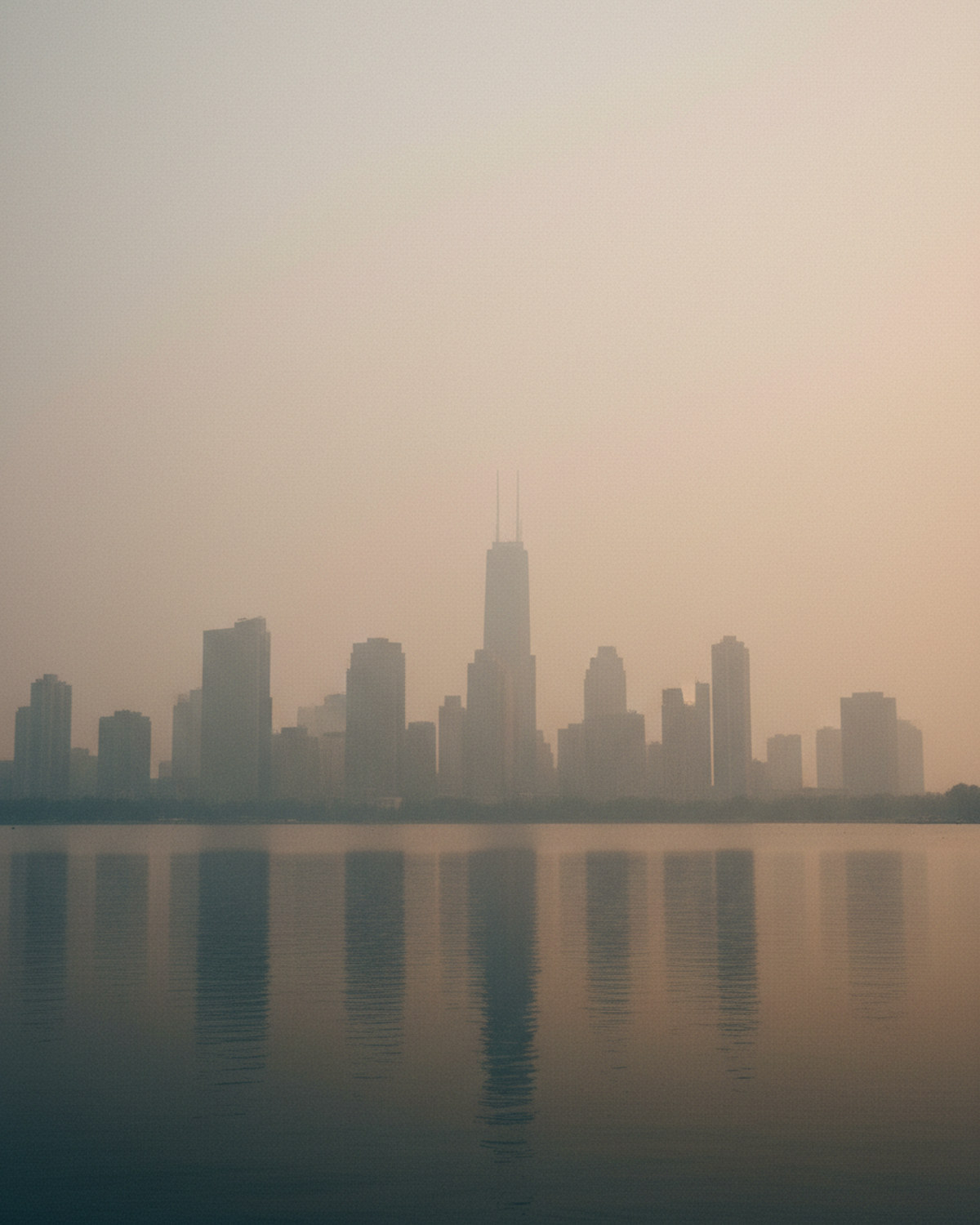
Los Angeles County has issued repeated ozone advisories this summer, but the same 2024 chamber study behind the smog-and-skin headlines found something the warnings leave out. Here is what the research actually supports, and what it does not.
Southern California has spent much of this summer under repeat ozone advisories, and each one arrives with the same blunt warning: bad air, stay inside, limit exertion. Los Angeles County Public Health issued a multi-day advisory from July 31 through August 2, 2026, as a heat wave pushed smog to unhealthy levels in Glendale and to unhealthy-for-sensitive-groups levels across the San Fernando, Santa Clarita, and San Gabriel valleys [1]. What almost never makes it into that advisory language is what ground-level ozone does to skin, and the honest answer is more layered than either the alarmist or dismissive version you'll find online.
What Ground-Level Ozone Actually Is
Tropospheric, or ground-level, ozone is not the same protective layer that sits in the stratosphere. It is a secondary pollutant, formed when heat and sunlight drive photochemical reactions between vehicle emissions and other airborne compounds [3]. That is why ozone advisories cluster around heat waves rather than around wildfire smoke events, which are dominated by particulate matter instead. It also means ozone concentrations peak on hot, sunny afternoons, exactly the hours most people are outside.
The Skin Chemistry Behind an Advisory
Ozone does not need to penetrate living tissue to affect skin. It reacts directly with squalene and other lipids sitting on the surface of the stratum corneum, producing secondary ozonides and aldehydes. Those byproducts can propagate oxidative stress into deeper layers, and the same review links this pathway to barrier disruption, increased water loss, and the matrix-metalloproteinase activity associated with visible photoaging over time [3]. On paper, that reads like a same-day skin emergency. The data on how fast it actually happens tells a different story.
The 2024 Study That Complicates the Ozone-Strips-Your-Skin Warning
A 2024 climate-chamber study published in Environmental Science and Technology exposed the forearms of human volunteers, including teenagers, young adults, and seniors, to controlled ozone levels and measured squalene in skin wipes before and after [4]. Squalene did drop in a statistically measurable way once normalized against co-occurring cholesterol. But the researchers also found something that rarely makes it into headlines built on that first result: at typical indoor and outdoor ozone concentrations, the rate of squalene loss from the ozone reaction was smaller than, or comparable to, how quickly skin naturally resecretes its own oil. Temperature and humidity within the tested ranges did not significantly change that balance. In plain terms, your skin's oil production is, in most everyday conditions, keeping pace with what ozone is breaking down. A single smoggy afternoon is not the same as a stripped barrier.
What a 2026 Human Trial Is Testing Right Now
That nuance is exactly why researchers are still running controlled human studies. A randomized trial out of Fudan University, completed January 28, 2026, exposed one forearm of 40 healthy adults to ozone while the other received clean air, then tracked skin changes and biological samples across multiple time points [2]. The fact that this kind of head-to-head, within-subject trial wrapped up just seven months ago says something on its own: the acute, real-world skin effects of ozone reaction products are still an open scientific question, not a settled one you should expect a single serum or advisory headline to have already resolved.
The Slower, Better-Documented Risk: Years of Ozone, Not One Afternoon
Where the science is more settled is on the cumulative side. Two German cohort studies, SALIA (806 women aged 66 to 79) and BASE-II (1,207 men and women aged 60 to 84), tracked five-year residential ozone exposure, defined as the number of days per year with a maximum 8-hour ozone average at or above 120 micrograms per cubic meter, against visible facial aging scored with a validated assessment tool. Both cohorts, separately and combined, showed a positive association between high-ozone days and coarse wrinkles, but not pigment spots, and that association held even after accounting for chronic UV exposure, particulate matter, and nitrogen dioxide [5]. That is the actual evidence base behind ozone-and-aging claims: years of repeated high-ozone days in a person's neighborhood, not the advisory currently posted for this week.
What Actually Helps During an Ozone Advisory
Given that framing, the useful response to an advisory is not panic about a single exposure, it's building habits that hold up over an entire ozone season. Ozone exposure is one of several factors researchers link to depleted surface antioxidants like vitamin E, so a vitamin C or vitamin E serum can help support the skin's own defenses on high-ozone days without needing to overhaul a routine. Rinsing your face after time outside on advisory days clears reacted lipids before they sit on skin longer than necessary. Sunscreen matters just as much during ozone advisories as it does on clear days, since UV and ground-level ozone are described in the research as having a synergistic, or photo-pollution-style, effect on skin rather than two separate risks that cancel each other out [3]. None of this is about undoing a single afternoon of smog; it's about not adding one more high-ozone day to a tally that, over years, is the part of the picture the German cohort data actually connects to visible wrinkling.
The Practical Takeaway
The next time an ozone advisory lands in your metro, the appearance risk to your skin is smaller and slower than the same-day language of the advisory implies; 2024 chamber data shows your skin's own oil production largely keeps pace with what a normal ozone exposure breaks down. What the research does support is a season-long pattern: antioxidant support, a rinse after being outside, and sunscreen you don't skip on hazy days, because the studies that actually link ozone to visible wrinkling are counting years of high-ozone days, not any single one on the calendar.