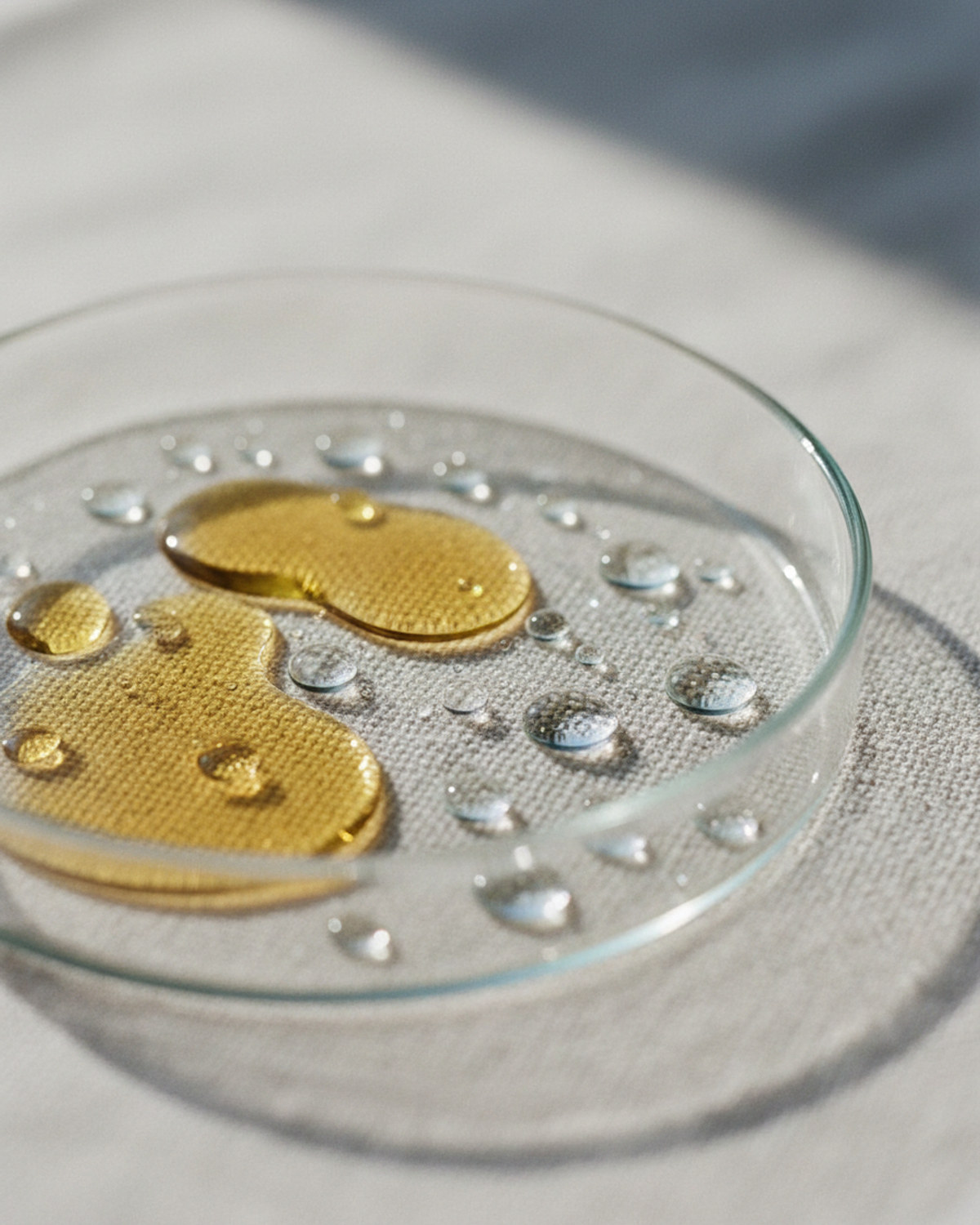
Niacinamide dissolves readily in water, yet products labeled as oils now list it. Here is what the reference data say and how to check a label.
Type 'niacinamide oil' into a search bar and you will see two kinds of results: facial oils that list niacinamide, and shoppers asking whether the pairing makes sense. The question is fair. Niacinamide is famously water-loving, and oils are, by definition, not. This guide looks at what the chemistry reference data say, what the research on niacinamide actually used as a delivery vehicle, and how to read an oil-style product label with those facts in mind.
Why the pairing raises eyebrows
PubChem's compilation of reference data lists nicotinamide, the chemical name for niacinamide, as very soluble in water. Several handbook entries it cites say 1 gram dissolves in about 1 milliliter of water, and one reports 500 grams per liter at 25 degrees Celsius. The same page reports that 1 gram dissolves in about 1.5 milliliters of alcohol and in about 10 milliliters of glycerol, and the only organic solvents it lists as dissolving niacinamide are butanol and chloroform. It gives no solubility figure for plant or mineral oils.
That absence is worth stating plainly. The reference page does not say niacinamide can never be carried in an oil product, and it does not say it can. It simply offers no oil data, while giving strong water and glycerol data. Anyone claiming a specific oil solubility number is going beyond what this source supports.
What this likely means inside a bottle
This section is inference from the solubility data, not a finding from a trial. Because niacinamide dissolves so readily in water, a product that carries it at a meaningful level usually needs some water phase. That could be an emulsion (a lotion or cream-style 'oil'), a water-in-oil system, or a two-part product. A clear, anhydrous oil that lists niacinamide may contain very little of it, or may be carrying it in a form other than simple dissolved niacinamide. The label alone will not tell you which.
Two practical clues are available on any ingredient list:
- Is water listed? If 'aqua' or 'water' appears near the top of the list, the product is at least partly water-based.
- Where does niacinamide sit? Ingredient lists are ordered by amount, so a niacinamide that appears after the preservatives, near the end of the list, is usually present at a low level.
What the research used as a vehicle
The key niacinamide studies were not run in facial oils. A 2005 safety assessment by the Cosmetic Ingredient Review expert panel described niacinamide use in around 30 formulation types, including shampoos, hair tonics, skin moisturizers, and cleansing products. In the human skin-barrier work, the researchers applied nicotinamide topically and reported higher ceramide and free fatty acid levels in the stratum corneum and lower transepidermal water loss in dry skin. The lab part of that study used cultured keratinocytes and concentrations of 1 to 30 micromoles per liter, which is not a percentage that can be mapped to a product.
A 2021 review noted that niacinamide is mainly formulated at 4 to 5 percent in cosmetics and described several trials as small, roughly 18 to 120 subjects. The take-home point: the published human data are about niacinamide in conventional cosmetic bases, not specifically in oils, so the evidence cannot be borrowed for an oil product without a caveat.
Concentration: context from the safety report
The 2005 CIR report listed niacinamide use levels from a low of 0.0001 percent in night preparations to a high of 3 percent in body and hand creams, lotions, powders, and sprays. That report is older than current marketing, and the 2021 review describes 4 to 5 percent as the usual cosmetic range. Both figures are useful anchors. If an oil lists niacinamide and claims a concentration well above those ranges, the claim is worth questioning, because it exceeds what these sources describe and the solubility data suggest it would be hard to achieve in a water-free oil.
The CIR abstract also reports that, in animal tests, skin sensitization to niacinamide at 5 percent during induction and 20 percent during challenge was negative in guinea pigs, and that irritation of up to 2.5 percent in rabbits was marginal. Animal data cannot predict how your own skin will respond, which is why a patch test still matters.
What an oil may still do for you
None of this makes a facial oil a bad product. Oils are valued for how they feel and for slowing water loss from the surface, and many people like the cushion they add to a routine. The point is narrower: if your reason for buying is niacinamide specifically, an oil is a hard place to confirm you are getting it, while a water-based serum or lotion is a format where the published research sits more comfortably.
How to shop and test
- Read the first ten ingredients and look for water or an emulsifier.
- Find niacinamide on the list and note whether it comes before or after the preservative.
- Ignore front-label percentages unless the brand states the amount and the format supports it.
- Patch test on the inner forearm for several days, then introduce the product on its own.
- If you want niacinamide and an oil, consider using a water-based niacinamide product first and sealing it with a few drops of oil afterward. This is a routine idea, not a tested protocol.
- Judge after four weeks or more, since the trials discussed in the review ran for weeks, not days.
The takeaway
Niacinamide is a water-soluble ingredient with strong published data in conventional cosmetic bases. A 'niacinamide oil' is not automatically a misleading product, but the chemistry reference gives you no reason to assume it delivers the same thing as a niacinamide serum. Check for water on the label, look at where niacinamide sits in the list, and treat percentage claims with care.