Two retinol products at the same percentage can look nothing alike on skin because the cream, gel, or serum carrying the retinol changes how it absorbs, how it feels, and how fast it degrades. Here is what the formulation research actually shows.
Search retinol cream and most guides jump straight to a percentage: start at 0.3%, work up to 1%, buy whatever number matches your experience level. That advice skips the part of the label that actually explains why two products at the same percentage can perform so differently - the vehicle, meaning the cream, gel, or serum base the retinol is dissolved or suspended in.
The Percentage Is Only Half the Formula
Retinol itself is a fairly unstable, oily molecule. On its own it does very little for how skin looks - it has to survive storage, get released from its base, and cross into the outer skin layers before it can do anything. The base handles all three of those jobs, and different bases handle them differently. A 2024 review in Dermatology Research and Practice walked through the delivery systems formulators now use to manage this: liposomes, solid lipid nanoparticles, nanostructured lipid carriers, polymer complexes, and cyclodextrins, each designed to control how quickly the retinol releases into skin rather than dumping it all at once. That release speed is the real variable behind whether a product feels gentle or harsh - not just the number on the front of the bottle.
What a Split-Face Trial Found When Only the Base Changed
The clearest demonstration of this comes from prescription retinoid research, where the active ingredient and concentration can be held perfectly constant while only the base changes. A 2022 study in the Journal of Drugs in Dermatology compared a branded 0.05% tretinoin lotion, built on a polymeric emulsion technology, against a generic 0.05% cream, applied to opposite sides of the same faces. At the two-week mark, the cream side showed 122% to 144% greater erythema, scaling, and dryness than the lotion side, a statistically significant gap despite the identical drug concentration. About 70% of participants said they preferred to keep using the lotion, citing comfort and how easily it spread. That study used prescription tretinoin, not over-the-counter retinol, but it isolated exactly the variable that decides how a retinol cream feels: identical active ingredient, identical concentration, different base.
Why a Higher Percentage Doesn't Always Mean a Bigger Difference
The same logic shows up in research on over-the-counter retinol specifically. A 2020 clinical trial in Skin Pharmacology and Physiology tested 0.3% and 0.5% retinol serums built on a liquid crystal vehicle, a structured arrangement of surfactant and oil designed to mimic the skin's own lipid layers and improve how the retinol moves through the outer skin. Over the study period, both concentrations produced similar improvements in the appearance of hyperpigmentation and hydration - roughly 15% to 23% and 18% to 26%, respectively - with no meaningful difference in outcome between the two strengths. What did differ was tolerability: the 0.5% side produced noticeably more peeling, redness, and itching than the 0.3% side. In other words, doubling the percentage bought almost nothing in visible results but a real increase in how reactive skin looked - a trade that the vehicle, not the concentration, ultimately controlled.
The Packaging Problem That Undoes All of That Formulation Work
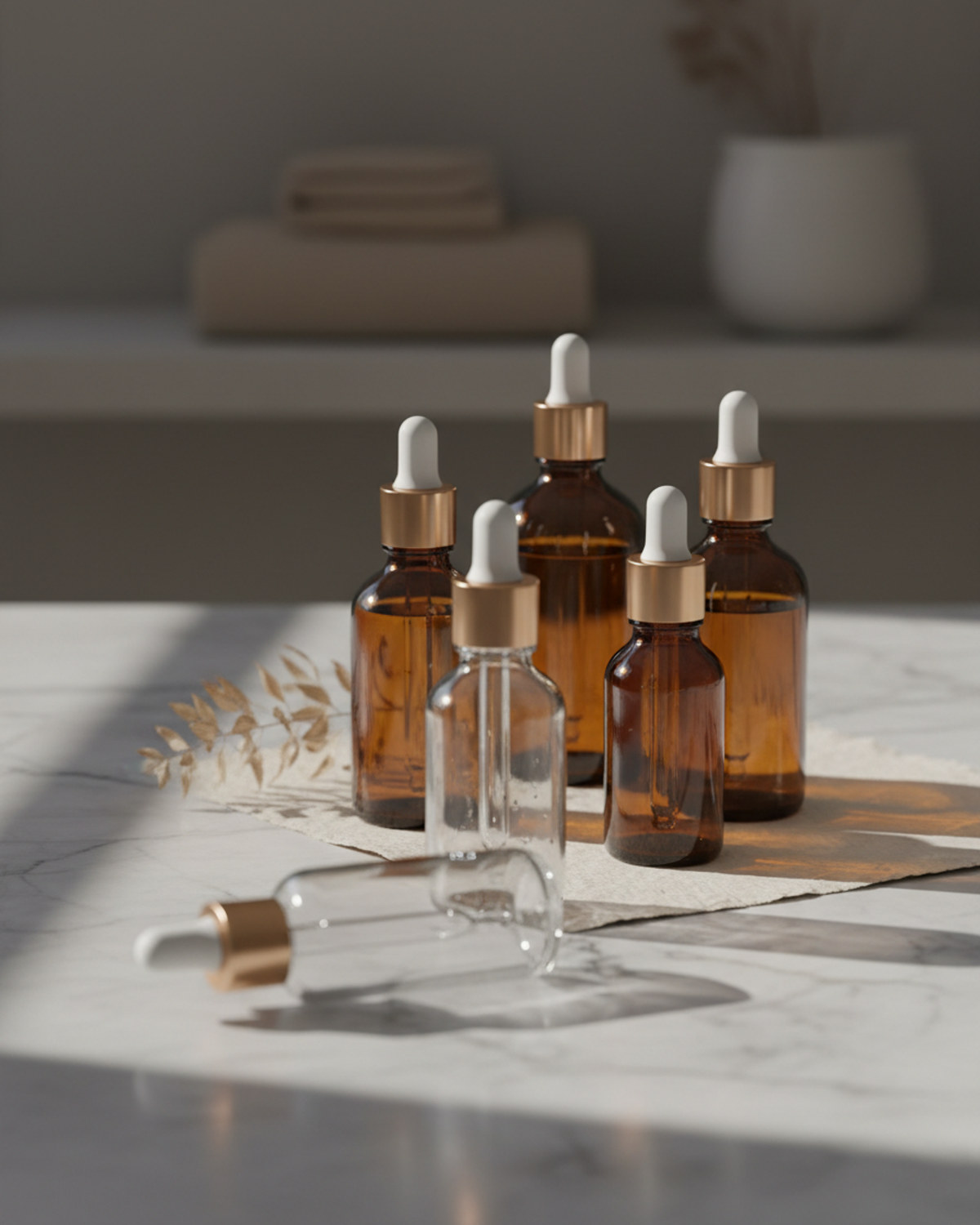
Even a well-engineered vehicle can't protect retinol from a bad container. A 2024 study out of Universitas Indonesia used HPLC testing to track retinol levels in two commercial face serums (labeled at 1% and 0.3%) over 30 days after opening, under different storage setups. Left in their original opaque bottles and kept away from light, the serums lost 25% to 31% of their retinol by day 30. Left in the original bottle but exposed to light, losses climbed to 35% to 42%. But when the product was decanted into a secondary clear glass jar and exposed to light - the setup used by the share-in-jar trend, where a product is split into smaller containers - losses reached 71% to 79% in the same 30 days, an average weekly decline of about 17%. No amount of liposome or liquid-crystal technology in the original formula survives that kind of exposure; the container did more damage than the vehicle ever prevented.
How to Read a Retinol Label Like a Formulator
A few label and packaging habits translate the research above into something usable at the shelf:
- Treat words like encapsulated, microsphere, liquid crystal, or time-release as signals that the brand is managing release speed, not just marketing language - this is the exact mechanism the 2024 formulation review described as reducing irritation potential.
- Check the container before the percentage. An opaque pump, foil-sealed tube, or dark glass bottle protects against the light and air exposure that measurably degraded retinol in the 2024 stability study. A clear jar is a liability regardless of what percentage is printed on it.
- If a serum consistently leaves skin looking flushed or flaky, a cream or lotion vehicle at the same percentage may behave differently before assuming the percentage itself needs to drop - vehicle-driven tolerability differences showed up clearly in both the tretinoin split-face study and the retinol serum trial above.
- Don't assume a higher percentage guarantees a visibly bigger result. The liquid-crystal serum trial found comparable outcomes at 0.3% and 0.5%, with the higher strength mainly adding reactivity rather than additional improvement.
- If a retinol product came from a jar-splitting or decanting service, budget for faster fade: the 2024 HPLC data suggests roughly a third of its potency can be gone within two to three weeks under normal light exposure.
Practical Takeaway
Before comparing retinol products on percentage alone, look at what's carrying the retinol and what it's packaged in. A well-formulated 0.3% in an opaque, encapsulated base can outperform a poorly packaged 1% left in a clear jar on a sunny shelf - the research above shows the vehicle and the container do more work than the number on the front label.
Guidance that learns with you
Rituelle reads your skin over time and adapts your routine to it.
Join the waitlist